-
- News
-
Categories
- 5G
- ADSL
- AI
- Banking
- Black Friday
- Broadband
- Broadcasting
- Business
- Business Telecoms
- Cellular
- Cloud and Hosting
- Columns
- Cryptocurrency
- Energy
- Enterprise
- Fibre
- Gadgets
- Gaming
- Government
- Hardware
- Industry News
- Internet
- Internet of Things
- Investing
- IT Services
- Motoring
- Reviews
- Science
- Security
- Smartphones
- Software
- Technology
- Telecoms
- Trending
- Wireless
- Press Office
- Forum
- Industry News
- What's Next
- Company hub
- Speed Test
- About us
- Advertise with us
- Contact
- Careers


-
Join the MyBroadband community
South Africa’s biggest forum. Discuss, discover, and connect with thousands of members.
-
Question of the Day: Which compact crossover would you choose?

You are using an out of date browser. It may not display this or other websites correctly.
You should upgrade or use an alternative browser.
You should upgrade or use an alternative browser.
Nokia (and Microsoft) versus Android and Apple
- Thread starter rpm
- Start date

Elimentals
Honorary Master
Yeah, they let stupid patents through all the time. Apple will never be able to actually enforce the patent. It's just a worthless piece of paper. But some lawyer at Apple thought it'd be a good idea to do.
Not really, its actually a brilliant idea, even if you hold crap patents, just ask Microsoft.
The problem is not the quality of the patent or the validity that counts, its the number of them. If you hold 10 000 patents and you take someone to court the onus is the person being sued to prove that they not infringing. So what happens is a company can either settle out of court and pay a license fee or spend years and millions trying to prove that each and every patent is invalid. In the end the company being sued lose money anyway, and in turn has to recouped by raising prices. So yes in the end we the end user end up paying for a broken system.
That is why I call it the new age Mafia, because its nothing more than a pay me or I break your knee caps.
elvis_presley
Expert Member
If you hold 10 000 patents and you take someone to court the onus is the person being sued to prove that they not infringing.
Are you sure about that? Got any links/info? From what I've read, you have to give very specific accusations of what patent they're infringing, not "here are 10,000 patents, you might infringe on some, have fun". The person suing would have to go through all 10,000 patents and show how the product infringed on each of them.

KleinBoontjie
Honorary Master
Not sure I agree with the comparison as the three produce different components
and there is a huge difference in sales.
MS is an [-]true[/-] unfair competitor by using the FAT disk layout patents against Linux to
- Apple makes handset + OS
- Android makes OS only
- Nokia make only handsets
- MS makes OS + Patent war
coerce handset makers to pay up.
AFAIK, you are not allowed to patent structures, only methods, but the flawed USPO granted it.
Both iOS and Android far outsell WP7 - so much so, that WP7 is almost a rounding error in the statistics.
Apple sold more iPhone 4S in 3 days (4m), than MS sold WP7 in 1 year.
So I don't see how MS can be considered a competitor.
MS makes more $$$ from Android than WP7.
Not. Apple actually makes the OS, not the handset.
Who makes the Iphone? Click here

Elimentals
Honorary Master
Are you sure about that? Got any links/info? From what I've read, you have to give very specific accusations of what patent they're infringing, not "here are 10,000 patents, you might infringe on some, have fun". The person suing would have to go through all 10,000 patents and show how the product infringed on each of them.
I was using an imagery example but in any case:
My own introduction to the realities of the patent system came in the 1980s, when my client, Sun Microsystems--then a small company--was accused by IBM of patent infringement. Threatening a massive lawsuit, IBM demanded a meeting to present its claims. Fourteen IBM lawyers and their assistants, all clad in the requisite dark blue suits, crowded into the largest conference room Sun had.
The chief blue suit orchestrated the presentation of the seven patents IBM claimed were infringed, the most prominent of which was IBM's notorious "fat lines" patent: To turn a thin line on a computer screen into a broad line, you go up and down an equal distance from the ends of the thin line and then connect the four points. You probably learned this technique for turning a line into a rectangle in seventh-grade geometry, and, doubtless, you believe it was devised by Euclid or some such 3,000-year-old thinker. Not according to the examiners of the USPTO, who awarded IBM a patent on the process.
After IBM's presentation, our turn came. As the Big Blue crew looked on (without a flicker of emotion), my colleagues--all of whom had both engineering and law degrees--took to the whiteboard with markers, methodically illustrating, dissecting, and demolishing IBM's claims. We used phrases like: "You must be kidding," and "You ought to be ashamed." But the IBM team showed no emotion, save outright indifference. Confidently, we proclaimed our conclusion: Only one of the seven IBM patents would be deemed valid by a court, and no rational court would find that Sun's technology infringed even that one.
An awkward silence ensued. The blue suits did not even confer among themselves. They just sat there, stonelike. Finally, the chief suit responded. "OK," he said, "maybe you don't infringe these seven patents. But we have 10,000 U.S. patents. Do you really want us to go back to Armonk [IBM headquarters in New York] and find seven patents you do infringe? Or do you want to make this easy and just pay us $20 million?"
After a modest bit of negotiation, Sun cut IBM a check, and the blue suits went to the next company on their hit list.
From http://www.forbes.com/asap/2002/0624/044.html And yes I know its IBM vs Sun but I am sure the Microsoft vs Acer/HTC/Samsung...... cases look very much the same.
If you do wanna fight it in court, they will use 3 or say 10, when you win they will just use the next number till they get something that sticks, seeing that you the person being sued end up with most of the costs, you learn fast to cut a check and run instead of spending time in court.
Last edited:
elvis_presley
Expert Member
If you do wanna fight it in court, they will use 3 or say 10, when you win they will just use the next number till they get something that sticks, seeing that you the person being sued end up with most of the costs, you learn fast to cut a check and run instead of spending time in court.
Yeah that would work on a small company, but MS is getting money from Samsung (who has more turnover than Microsoft and Apple combined, and owns insurance firms and investment banks, and entire buildings full of lawyers). If Samsung didn't put up a fight, I'm willing to accept the claims were valid.
I'm not saying strong-arming doesn't happen, but MS can't strongarm Google or Samsung. There aren't enough lawyers in the chartered universe for that stand-off.
Mr.CookieMonster
Expert Member
What Nokia did by teaming up with Microsoft is a good idea!
Symbian OS was too bulky and dull if you ask me.
Im just bleak the Windows App Store does not have many apps. Hope this improves in time.
When Will Nokia make its first Dual Core Smartphone?
Symbian OS was too bulky and dull if you ask me.
Im just bleak the Windows App Store does not have many apps. Hope this improves in time.
When Will Nokia make its first Dual Core Smartphone?
What Nokia did by teaming up with Microsoft is a good idea!
Symbian OS was too bulky and dull if you ask me.
Im just bleak the Windows App Store does not have many apps. Hope this improves in time.
When Will Nokia make its first Dual Core Smartphone?
When apple and android have quad or octa cores...


Rouxenator
Dank meme lord
Perhaps its time we all think about the origin of mobile phones...

Ah yes - there it is, Nokia, they practically made the world as we know it.
If you look at the picture below, I still have the phone on the right, sold the one the left two weeks after taking the picture :

Ah yes - there it is, Nokia, they practically made the world as we know it.
If you look at the picture below, I still have the phone on the right, sold the one the left two weeks after taking the picture :
Perhaps its time we all think about the origin of mobile phones...
Ah yes - there it is, Nokia, they practically made the world as we know it.
If you look at the picture below, I still have the phone on the right, sold the one the left two weeks after taking the picture :
Perhaps it's time we think about the origin of the PC

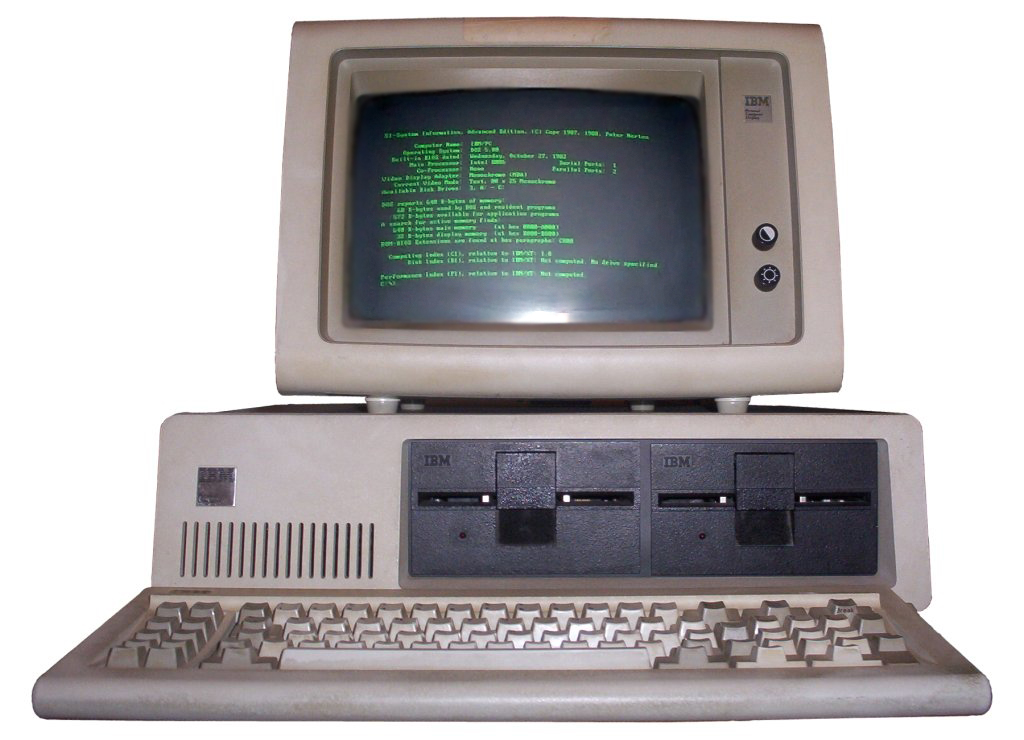
Doesn't make IBM any more desirable today...
Elimentals
Honorary Master
Yeah that would work on a small company, but MS is getting money from Samsung (who has more turnover than Microsoft and Apple combined, and owns insurance firms and investment banks, and entire buildings full of lawyers). If Samsung didn't put up a fight, I'm willing to accept the claims were valid.
I'm not saying strong-arming doesn't happen, but MS can't strongarm Google or Samsung. There aren't enough lawyers in the chartered universe for that stand-off.
Its not about income, its about time spent in court. Or the where the debate started number of patents they can try it with.
Let me put it this way, Samsung in your example can either pay up, say for example $20 million or spend 1 to 2 years in court and have a 50/50 chance to win, if they do win Microsoft can just pull the next 5 and tie them up again... till they find the 2 that Samsung does infringe and the court then decide what the penalties are. So the court can rule that they either pay $1 or $100 million. So its quicker to just cut the check and call it a day. Also note that Samsung do not hold the number of software patents that Microsoft or Google does.
Like I said, its all good, at least its better than Apple's system.
Lets just hope for the US sake it does not become too much and developers start splitting software based on regent. Cause that is the day the USA will surely start to lose big time.
Elimentals
Honorary Master
Perhaps its time we all think about the origin of mobile phones...
Ah yes - there it is, Nokia, they practically made the world as we know it.
Erm Wrong, the cell phone was invented by Motorola

http://en.wikipedia.org/wiki/History_of_mobile_phones#Handheld_cell_phone
Lets just hope for the US sake it does not become too much and developers start splitting software based on regent. Cause that is the day the USA will surely start to lose big time.
Actually I'm hoping that this happens. It's the only thing that will force them to resolve their broken patent system. They already did the same thing with encryption methods anyway.
McGuywer
Executive Member
Erm Wrong, the cell phone was invented by Motorola
http://en.wikipedia.org/wiki/History_of_mobile_phones#Handheld_cell_phone
Quoted for the truth...
Erm Wrong, the cell phone was invented by Motorola
http://en.wikipedia.org/wiki/History_of_mobile_phones#Handheld_cell_phone
Which probably makes Motorola the most valuable acquisition in a patent war
Which probably makes Motorola the most valuable acquisition in a patent war
Not if most of their key patents are covered in FRAND agreements, and not if they had already sold off a lot of their patents.
Elimentals
Honorary Master
Not if most of their key patents are covered in FRAND agreements, and not if they had already sold off a lot of their patents.
Will have to see... http://fosspatents.blogspot.com/2011/10/samsungs-attempt-to-ban-iphone-4s-over.html
That reminds me, Apple expects to use every body else FRAND patents but refuse to make any of their own FRAND.
Perhaps its time we all think about the origin of mobile phones...
Ah yes - there it is, Nokia, they practically made the world as we know it.
Pure ignorance... quickly rebuked by the following posts at least