Retirement Annuity Fund

Where are your properties, Rwen, as I am as interested in this as I am in your investments which you can do with no costs? Most people I know are battling to get enough rent to cover bond repayments and also finding that the properties have a lot less equity in them than they would have hoped...

Rwen, you cannot DO IT YOURSELF and still get the tax deductibility unless you are starting your own SARS approved retirement fund that I am unaware of! Your post insinuates avoiding any of the big approved funds as they are sharks, rapists etc etc.

1. No chance, baby - I don't tell things that might identify me.

2. I never said there were no costs. Rent received is not regarded as a return - it is ploughed back into the properties in one way or another, after tax.

3. Sure, the market has slumped. It goes in cycles. BLASH.

4. Capital gains tax ain't too bad LOL!

5. Brokers, big funds, sharks, rapists, yup! Go looky look at Noseweek on Investec for example. Nedbank too. Nice people!
 
Well I'll leave this thread to Rwen then, as he seems to have the ultimate solution for retiring financially independent and has all the answers.

So guys, do not bother maximising your tax deductibility within your investments. A guaranteed 40% return, if you are on the maximum tax rate (which of course is never factored into those terrible returns Rwen refers to...), can apparently be achieved elsewhere... This saving must apparently be ignored as you may attract costs of around 2% of your contributions on your investment.

In conclusion I would however refer you to persfin.co.za for a little reading after you have had some fun reading through the noseweek.
 
Go looky look at Noseweek on Investec for example. Nedbank too.

That will be swept under the carpet methinks - I hope not, for the sake of justice, but I hope so for the sake of my investments...:o

There is much more going on that was Noseweek uncovered IMO - I sincerely hope they do a follow up...
 
Well I'll leave this thread to Rwen then, as he seems to have the ultimate solution for retiring financially independent and has all the answers.

So guys, do not bother maximising your tax deductibility within your investments. A guaranteed 40% return, if you are on the maximum tax rate (which of course is never factored into those terrible returns Rwen refers to...), can apparently be achieved elsewhere... This saving must apparently be ignored as you may attract costs of around 2% of your contributions on your investment.

In conclusion I would however refer you to persfin.co.za for a little reading after you have had some fun reading through the noseweek.

Aw Lancelot! I was just trying to give the OP a warning to be careful. You just started rubbishing what I said - so I had to respond. I'm sure your stuff is good, as these things go. What worked and works for me might not for someone else.

:)
 
Well it's tough for me to continue commenting on this thread Rwen. You can comment as you please but I need to tread carefully so it makes it an unfair fight. I need to try and maintain my integrity even if this is an anonymous forum... who knows if my identity gets out one day and I am then held responsible for my comments.

I can give all the facts but with the industry I am in it will just come across as me saying what I would be expected to say. You can, however, make the popular calls of the big companies ripping off the little man and probably get a fair bit of support, as we all like to support David in these cases, so it is a no win for me really. No matter whose comments are more factual it is the popular view that often wins through.

So yeah I will often correct blatant untruths I see but as stated in my first post I am always stuck between rather staying away and not getting involved or making comments.
 
Well it's tough for me to continue commenting on this thread Rwen. You can comment as you please but I need to tread carefully so it makes it an unfair fight. I need to try and maintain my integrity even if this is an anonymous forum... who knows if my identity gets out one day and I am then held responsible for my comments.

I can give all the facts but with the industry I am in it will just come across as me saying what I would be expected to say. You can, however, make the popular calls of the big companies ripping off the little man and probably get a fair bit of support, as we all like to support David in these cases, so it is a no win for me really. No matter whose comments are more factual it is the popular view that often wins through.

So yeah I will often correct blatant untruths I see but as stated in my first post I am always stuck between rather staying away and not getting involved or making comments.

I'm sorry. I get carried away sometimes. I'll back off.
 
This is not exactly true. If there is negative growth then you will not even have this 40%...

Nope, it is still true as the 40% of your contributions will be refunded to you when you submit your tax return, unless of course you get your HR department to adjust your pay slip monthly as they are entitled to do. So you are guaranteed to get this back!

Your portfolio performance is a long term thing so cannot be factored in until the policy has run it's term. If you achieve a negative return over any period of more than 5 years then you/your adviser have done something drastically wrong in your portfolio choices!

Even if fully invested in equities the probability of a negative return over any 3 year period is 7%, over 4 years this drops to 0% (based on historical JSE data). The reason long term investors lose money is because they buy out when markets start to turn bearish and they have already lost (fear) and then buy back in when the markets turn bullish again but they have already missed the boat (greed). Stay put and stick to your investment strategy and you should not be making negative returns over an 5 year period!
 
Nope, it is still true as the 40% of your contributions will be refunded to you when you submit your tax return, unless of course you get your HR department to adjust your pay slip monthly as they are entitled to do. So you are guaranteed to get this back!

Your portfolio performance is a long term thing so cannot be factored in until the policy has run it's term. If you achieve a negative return over any period of more than 5 years then you/your adviser have done something drastically wrong in your portfolio choices!

Even if fully invested in equities the probability of a negative return over any 3 year period is 7%, over 4 years this drops to 0% (based on historical JSE data). The reason long term investors lose money is because they buy out when markets start to turn bearish and they have already lost (fear) and then buy back in when the markets turn bullish again but they have already missed the boat (greed). Stay put and stick to your investment strategy and you should not be making negative returns over an 5 year period!

I agree 100% on the longer term. I am just saying that if I take my R600 as well as the R400 from SARS and invest it but at the end of the year it is worth only R900 then I do not get a GUARANTEED 40% return... (only 30% which is still not bad :D)
 
I agree 100% on the longer term. I am just saying that if I take my R600 as well as the R400 from SARS and invest it but at the end of the year it is worth only R900 then I do not get a GUARANTEED 40% return... (only 30% which is still not bad :D)
Just my 2c.

Anything from 5% return above CPI is brilliant in the long term. People have gotten used to supranormal returns over the last 6 years. In my line of business, it's usual to assume about 3%-4% in excess of CPI return over the long term for an equity investment when doing projections over the long term (ie, 10-40 years).

The additional risk you're incurring in an equity or property investment above the risk free, or government bond rates, is not commensurate with a return of 30% in excess of CPI, which is what an average balanced retirement fund or RA investment should have earned p.a. for 2005, 2006 and the first half of 2007. The JSE All Share index doubled over two and a half years! That's certainly not sustainable over the long term.

Theoretically it is always to your advantage to maximise your RA contributions. Even if the fees charged are ridiculously high, your RAs should still outperform a pure equity investment. Most balanced RAs these days have a reduction in yield (due to fees, commission, etc) of about 2% p.a.
 
Last edited:
Just my 2c.

Anything from 5% return above CPI is brilliant in the long term. People have gotten used to supranormal returns over the last 6 years. In my line of business, it's usual to assume about 3%-4% in excess of CPI return over the long term for an equity investment when doing projections over the long term (ie, 10-40 years).

I'm very curious about this implied correlation between CPI and equity performance over the long term.

Also, lets assume CPI remains within the target range and that my long term investment yields your projected return cumulatively - that's less than a 10% return. A few darts and the business day will return better than that over the long-term.

The additional risk you're incurring in an equity or property investment above the risk free, or government bond rates, is not commensurate with a return of 30% in excess of CPI

You show me a single government, municipal or other govt backed bond with a coupon+price return higher than the ALSI long-term return, and I'll eat my socks. Equities are only risky if traded on a short term basis or if moving well outside of the blue-chip range or investing solely in AltX or other penny stocks.

Also, lets not forget that govt bonds are not used as investments, but rather a hedging instrument. There is a very good reason why Goldfields for instance doesn't hedge against the gold price. If you were looking at a fundamentally level playing field, with a guaranteed, long-term surge in commodities prices, who would you rather be invested in - Goldfields or Harmony? Goldfields! I'm using this as an analogy as to why your logic is flawed. We know that equities will increase over the long-term, as will most other investment instruments. Also, there is no such thing as a risk-free investment - a govt bond is very low risk, but not risk free - just think about what would happen to your precious government bond hedges if the SA economy went the way of our Northern neighbours? I'd sooner be exposed to equities at that point because they would have to outperform inflation for industry to sustain itself...

Theoretically it is always to your advantage to maximise your RA contributions.

Now you're just spewing salesman talk. RA is a highly illiquid investment and maximizing these contributions is far from ideal to many people, in many situations. To make such a blanketting statement is irresponsible.

Even if the fees charged are ridiculously high, your RAs should still outperform a pure equity investment.

Again, more salesman talk. This is far from true - if it were, asset managers would not provide equities only funds. I'm curious as to what other investment instruments you think are at the portfolio manager's disposal that will outperform equities only over the long-term, considering the nature of the portfolio. i.e. it is a hedged, low risk portfolio and therefore has little to no exposure to commodities, CFDs, high-yield bonds, geared derivatives etc etc.

See Lancelot - this is what I was referring to in the other thread about anyone and sundry and their parrot-fashion repetition...
 
Last edited:
I'm very curious about this implied correlation between CPI and equity performance over the long term.

If I may..... :)

It is used as a benchmark DJK, there is no direct correlation. If CPI were 20% and you achieved a return of 12% this would not be of much use to you. Likewise if CPI were 2% and you achieved 10% you should be fairly chuffed. Now it makes sense therefore to rather state a return relative to CPI (ie real return) rather than throwing about wild figures like 20% and failing to mention that CPI was running qt 19.5% at the same time.


Also, lets assume CPI remains within the target range and that my long term investment yields your projected return cumulatively - that's less than a 10% return. A few darts and the business day will return better than that over the long-term.

The poster was talking about sustained return over a long term (in all likelihood over 20 years for an RA). You are also talking about stock picking and predicting markets, most people lose more money through this type of investing than make. I have posted a graph before showing exactly how most people disinvest when markets are nearing the bottom and reinvest when it is about to peak! I am sure I do not need to quote figures again of what missing the best 10 days, 30 days etc in the market can do to an investment over the long term. Your strategy might be fine for you and you might have the time to ensure it works but most people don't. I personally feel, to quote you, that to make such a blanketing statement in suggesting people follow your strategy rather than investing in RAs etc, is irresponsible. Historical data shows this and I can happily post the graphs etc if you so desire.

I think you will find it also has to do with being once bitten, twice shy. Investment houses are not willing to make outrageous promises when it comes to returns. Promise 5% in excess of CPI, achieve 10% in excess and everyone is happy. Promise 10% in excess and achieve 5% and you are sitting in front of the pension funds adjudicator! :)


You show me a single government, municipal or other govt backed bond with a coupon+price return higher than the ALSI long-term return, and I'll eat my socks. Equities are only risky if traded on a short term basis or if moving well outside of the blue-chip range or investing solely in AltX or other penny stocks.

I'm with you on this. No other asset class can touch equities when it comes to long term growth. Again I have posted before regarding the prospects of equities as a whole losing you money over the long term but to reiterate, based on South African historical data, the probability of equities performing negatively over any four year period is 0%, down from only a 7% probability over three years.

Out of interest, and on this topic :

AssetClasses.jpg


And yet I STILL hear people advising others to rather just put their money into money market!! On this forum!!!


Now you're just spewing salesman talk. RA is a highly illiquid investment and maximizing these contributions is far from ideal to many people, in many situations. To make such a blanketting statement is irresponsible.

No one said anything about liquidity... or at least I hope they didn't. The whole idea of an RA, and in fact for most people another positive as they can't just access the money for that new computer they want or that holiday that looks so appealing, is that the money is not accessible before 55. And of course this also means it is not able to be touched by creditors when the sh_t hits the fan like your lovely liquid investments can.

I do not feel it is at all irresponsible to be saying that every single person should be taking advantage of the tax breaks offered on an RA (but of course I will be accused of talking like a salesman)... well actually in fact the only people who will not benefit are those earning below the tax threshold but then even they need to do something for their retirement and are most likely to need those funds protected.

Out of interest, besides those unemployed or below the tax threshhold who else should not be making use of an RA?

Out of interest you will find that even Bruce Cameron, editor of personal finance, who loves taking swipes at the long term industry states that every individual should be taking advantage of the tax breaks RAs offer. Not that his view should carry any more weight than anyone else's... ;)


Again, more salesman talk. This is far from true - if it were, asset managers would not provide equities only funds. I'm curious as to what other investment instruments you think are at the portfolio manager's disposal that will outperform equities only over the long-term, considering the nature of the portfolio. i.e. it is a hedged, low risk portfolio and therefore has little to no exposure to commodities, CFDs, high-yield bonds, geared derivatives etc etc.

I agree that his statement was not made clear enough but my understanding is that he was not referring to the RA policy outperforming equities in terms of returns but rather after you factor in the tax break you have been given (from 18 - 40%). An RA in itself is merely a vehicle through which one invests in the various asset classes. If you are an aggresive long term investor you could well be invested fully in equities via your RA through perhaps an ALSI 40 portfolio, so the performance of your RA portfolio will be exactly the same as any other ALSI 40 investment (with the same investment mandate, decisions, buys, sells being made etc!) however the RA gives you the tax break. Yes, in exchange for your money not being liquid but that is the idea anyway, to not access it until retirement...

It also needs to be mentioned that returns within an RA fund are not taxed at all (it used to be at 18% then was reduced to 9% but it is now 0%). Now this will not matter in the case of equities, of course, but other asset classes usually accrue taxes of 30% within the long term companies hands via the four fund tax approach, if not in an RA fund (not so for collective investments and linked products as these are taxed in the owner's hands - but again something to consider if you are on 40% tax rate)

See Lancelot - this is what I was referring to in the other thread about anyone and sundry and their parrot-fashion repetition...

Yip, I get what you are saying... but I think the main thing people need to realise is that "advice" given on here often verges on opinion. The people giving it are anonymous so there can be no come backs if the advice given is bullsh_t. I think people need to accept it as such and then we should not have a problem....


EDIT : I wonder how many people actually read through entire posts like this one of mine and yours above! :) I fear not many ;)
 
Last edited:
I will go into more detail later as I've gotta duck out shortly, however:

If I may..... :)

It is used as a benchmark DJK, there is no direct correlation. If CPI were 20% and you achieved a return of 12% this would not be of much use to you. Likewise if CPI were 2% and you achieved 10% you should be fairly chuffed. Now it makes sense therefore to rather state a return relative to CPI (ie real return) rather than throwing about wild figures like 20% and failing to mention that CPI was running qt 19.5% at the same time.

OK, I was looking at it from a PV point of view. If you use it merely as a benchmark taking into account the time value of money then I see the point but I read the post as if there was some implied correlation.

The poster was talking about sustained return over a long term (in all likelihood over 20 years for an RA). You are also talking about stock picking and predicting markets, most people lose more money through this type of investing than make. I have posted a graph before showing exactly how most people disinvest when markets are nearing the bottom and reinvest when it is about to peak! I am sure I do not need to quote figures again of what missing the best 10 days, 30 days etc in the market can do to an investment over the long term. Your strategy might be fine for you and you might have the time to ensure it works but most people don't. I personally feel, to quote you, that to make such a blanketing statement in suggesting people follow your strategy rather than investing in RAs etc, is irresponsible. Historical data shows this and I can happily post the graphs etc if you so desire.

Not trying to make a blanketting statement to follow equities only - heck, I don't at all, however it forms an integral part of my long term investment strategy as I've discussed before. I was merely pointing out the fact that it is a dismal return in comparison to many other long-term growth products or investment strategies. Different strokes for different folks is kinda what you preach (and I agree), therefore to say that maximising RA contributions will always be best is pretty poor.

I think you will find it also has to do with being once bitten, twice shy. Investment houses are not willing to make outrageous promises when it comes to returns. Promise 5% in excess of CPI, achieve 10% in excess and everyone is happy. Promise 10% in excess and achieve 5% and you are sitting in front of the pension funds adjudicator! :)

My point being that you have very different types of funds with very different risk profiles. 3-4 percent above CPI (if we assume CPI remains within the target range) is a very low risk, low return investment and not one that everyone and their dog will be wanting to maximise on - hence the need for financial planners like yourself.

And yet I STILL hear people advising others to rather just put their money into money market!! On this forum!!!

They don't know any better. Money-market will always merely track inflation - nice little hedge in volatile times if you like, but not much of an investment, especially over the long term.

No one said anything about liquidity... or at least I hope they didn't. The whole idea of an RA, and in fact for most people another positive as they can't just access the money for that new computer they want or that holiday that looks so appealing, is that the money is not accessible before 55. And of course this also means it is not able to be touched by creditors when the sh_t hits the fan like your lovely liquid investments can.

While there was no specific mention of liquidity, I used it as an example as to why stating that increasing RA contributions is not always the best option for everyone. I could use other examples if you like, but liquidity becomes a major factor for some. See many people don't understand the inner workings of these long term contracts they tie themselves in to, and when the **** does hit the fan, they are left with major fees in trying to withdraw funds from a RA for instance, which negates any minimal returns they have made. Being asset rich means nothing if you have no liquidity...

And there are many other ways to protect one's equity investments from the creditors. A simple CC will do the trick.

I do not feel it is at all irresponsible to be saying that every single person should be taking advantage of the tax breaks offered on an RA (but of course I will be accused of talking like a salesman)... well actually in fact the only people who will not benefit are those earning below the tax threshold but then even they need to do something for their retirement and are most likely to need those funds protected.

Sure, take advantage of the tax breaks if those are your only options, however there are other ways to take advantage of the tax-man as well. All I am saying (and I think you will agree) is that there is no one size fits all approach - a practise you echo in all of your investment related posts. I find it irresponsible to suggest that one should always maximise teir RA contribution - that's rubbish!!

Out of interest, besides those unemployed or below the tax threshhold who else should not be making use of an RA?

Out of interest you will find that even Bruce Cameron, editor of personal finance, who loves taking swipes at the long term industry states that every individual should be taking advantage of the tax breaks RAs offer. Not that his view should carry any more weight than anyone else's... ;)

Everyone should be contributing towards a retirement fund. But it isn't the be all and end all of investing, not by a long shot. I even have one (can you believe it..:eek: :D ). Even if one doesn't invest directly, there are numerous other products with similar benefits, but over a much shorter term. Some of these might be more applicable than a RA for many people.

I agree that his statement was not made clear enough but my understanding is that he was not referring to the RA policy outperforming equities in terms of returns but rather after you factor in the tax break you have been given (from 18 - 40%). An RA in itself is merely a vehicle through which one invests in the various asset classes. If you are an aggresive long term investor you could well be invested fully in equities via your RA through perhaps an ALSI 40 portfolio, so the performance of your RA portfolio will be exactly the same as any other ALSI 40 investment (with the same investment mandate, decisions, buys, sells being made etc!) however the RA gives you the tax break. Yes, in exchange for your money not being liquid but that is the idea anyway, to not access it until retirement...

Again, it is not the be all and end all. I'm not disagreeing with you entirely (far from it, because what you mentioned is true). What got my tail feathers up was the mention that maximising RA contributions is ALWAYS beneficial. Hell, no it aint!!!!

It also needs to be mentioned that returns within an RA fund are not taxed at all (it used to be at 18% then was reduced to 9% but it is now 0%). Now this will not matter in the case of equities, of course, but other asset classes usually accrue taxes of 30% within the long term companies hands via the four fund tax approach, if not in an RA fund (not so for collective investments and linked products as these are taxed in the owner's hands - but again something to consider if you are on 40% tax rate)

Not taxed at the time of contribution, yes. But taxed when you receive the money AFAIK.

Yip, I get what you are saying... but I think the main thing people need to realise is that "advice" given on here often verges on opinion. The people giving it are anonymous so there can be no come backs if the advice given is bullsh_t. I think people need to accept it as such and then we should not have a problem....

Of course - mere opinions. Some weigh in with some absurd opinions though - the money market suggestions for one - those suggesting we pull out of equities entirely are another (sorry alf, I had to).

EDIT : I wonder how many people actually read through entire posts like this one of mine and yours above! :) I fear not many ;)

There's a reason I started with the finance sticky, but it didn't get much traction. Maybe time to rethink that idea...
 
Last edited:
Thanks for the advice people...

I'm getting worried about my broker as he didn't seem to sure which portfolio's to put my money in as he just looked at the fund's % performance based on the info off the web and he said that the property fund is good good good....
 
Hi DJK. I'm going to try to reply to your points as best as possible.
I'm very curious about this implied correlation between CPI and equity performance over the long term.
The relationship is usually specified as follows: The required return (note required and not expected) on an equity investment is the risk free return + expected inflation + an equity risk premium. The risk free return is simply the redemption yield available on conventional government bonds, which should be risk free (ie, the government will not default on a bond). Expected inflation can be approximated by determining the difference between the redemption yield on a conventional bond and that of a inflation linked bond (such as the R189, R197 or R198). The equity risk premium is that extra return required by an investor in order to compensate for the risk of an equity investment (ie, volatility, default, liquidity, marketability, etc). When working with real yields (already taking expected inflation into account), the important factor is the equity risk premium. It could be argued that expecting an equity risk premium in excess of 5% over the long term is unrealistic.
Also, lets assume CPI remains within the target range and that my long term investment yields your projected return cumulatively - that's less than a 10% return. A few darts and the business day will return better than that over the long-term.
I would like to know how you would manage that. Consistently having a real return in excess of 5% over the long term is pretty impressive IMO. I would like to see any evidence to the contrary.
You show me a single government, municipal or other govt backed bond with a coupon+price return higher than the ALSI long-term return, and I'll eat my socks. Equities are only risky if traded on a short term basis or if moving well outside of the blue-chip range or investing solely in AltX or other penny stocks.
That's my point. If you want returns in excess of the risk free yields, you're going to have to take risks, which means investing in equities. All I'm saying is that is imprudent to expect real returns of 5% p.a. over the long term.
Also, lets not forget that govt bonds are not used as investments, but rather a hedging instrument. There is a very good reason why Goldfields for instance doesn't hedge against the gold price. If you were looking at a fundamentally level playing field, with a guaranteed, long-term surge in commodities prices, who would you rather be invested in - Goldfields or Harmony? Goldfields! I'm using this as an analogy as to why your logic is flawed. We know that equities will increase over the long-term, as will most other investment instruments. Also, there is no such thing as a risk-free investment - a govt bond is very low risk, but not risk free - just think about what would happen to your precious government bond hedges if the SA economy went the way of our Northern neighbours? I'd sooner be exposed to equities at that point because they would have to outperform inflation for industry to sustain itself...
I agree with this and I think it reinforces my first point above. It's people who expect the extra return from equities and don't attach any risk to it that frustrates me.
Now you're just spewing salesman talk. RA is a highly illiquid investment and maximizing these contributions is far from ideal to many people, in many situations. To make such a blanketting statement is irresponsible.
OK, it's definitely not an appropriate investment if you're concerned about liquidity. You should only put money into an RA if you know that you can do without it for quite a long period of time. I do think that it is an excellent investment when you are trying to save specifically for retirement and you have the cash available to do so. eg. In 2006 an average balanced portfolio would have returned about 35%. Take into account the minimum 18% tax deduction and you had a return of about 59%! If you're in a higher tax bracket this would have been even better.

I'm definitely not a salesman! I thought it was generally accepted that actuaries \ actuarial students have no interpersonal skils.:D I don't think I can sell a raft to drowning man.
Again, more salesman talk. This is far from true - if it were, asset managers would not provide equities only funds. I'm curious as to what other investment instruments you think are at the portfolio manager's disposal that will outperform equities only over the long-term, considering the nature of the
portfolio. i.e. it is a hedged, low risk portfolio and therefore has little to no exposure to commodities, CFDs, high-yield bonds, geared derivatives etc etc.
Obviously equity has the best long term returns. My argument is simply that it's silly to expect in excess of 5% real return in the long term.
See Lancelot - this is what I was referring to in the other thread about anyone and sundry and their parrot-fashion repetition...
Ha.:p I'm not an advisor and so any of my statements should certainly not be taken as any kind of indication of what to do with your money.

My involvement is as follows: I work in the pension fund industry, and I'm constantly amazed when people start complaining that their equity investment has negative returns. I would have thought that it would be obvious to investors that equity returns are not guaranteed to give you the best returns, but that the expected return from equities is higher than for any other asset class over the long term.

PS. The reason why most pension projections are made on bases of returns of 3%, 4% and 5% in excess of inflation, is that you would expect people to get salary increases of about 1% in excess of CPI (excluding merit increases). A long term market neutral equity risk premium is generally about 2%-4% p.a. (as at September 2008 it is about 6%, markets are still expecting miracles...). This gets you back to the original assumed returns

The general message that I would like to get across is that people should not be unreasonable in what they expect from an investment. All of the assets classes have their pro's and cons and any investor should make sure that their particular investment strategy is suitable to their risk profiile.
 
Last edited:
Thanks for the advice people...

I'm getting worried about my broker as he didn't seem to sure which portfolio's to put my money in as he just looked at the fund's % performance based on the info off the web and he said that the property fund is good good good....

Oh dear a sure fire way of deciding whether you should be concerned about your broker is if he uses past performance as his reason for investing you in a particular portfolio... this is the same guy who would have invested you in tech stocks before they collapsed and anything offshore when the rand seemed like it was on a one way street versus the dollar...

Remember past performances are exactly that and are in no way indicative of possible future performances! They can be used to see how a portfolio has performed in it's sector when compared to it's peers but nothing more. Your portfolio choice should be based on a number of factors the most important being your risk profile and propensity for risk, your investment horizon as well as your investment objective.
 
I like pictures, so here are some more related to what we have been discussing! :)

First, this graph is especially for the money market and cash fans out there! This shows the performances of balanced portfolios (these are portfolios which usually have around 50-70% equity exposure with the rest invested in bonds, property and offshore, so in short they are "balanced" :) ) by a number of asset managers when compared to money market returns. And yes the period of time used may be unfair as we have been in a bull run but this has been tempered by the arrival of the bears in 2008, and you can see the balanced portfolios are still well up!

117.jpg


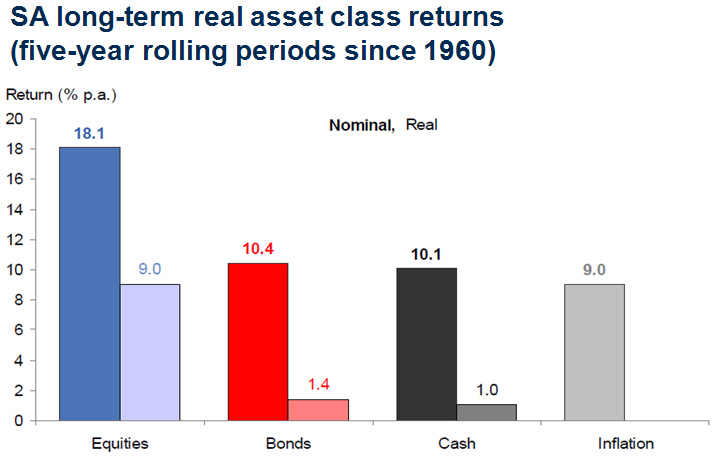
Second, we have a look at how equity has performed over the last 40 odd years when compared to the other asset classes and inflation. Not a fair contest really.... Now if this does not make the money market fans rethink their strategy then I don't know what will! :)

215.jpg


The third graph shows the probability of losing money when invested purely in equities over various time periods. I alluded to this earlier but here you can see how the risk of negative decreases and then no longer exists over any four year investment cycle!

39.jpg


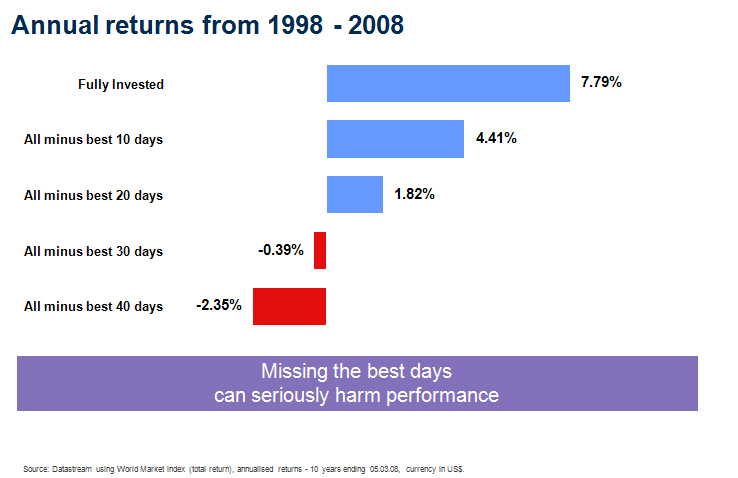
Finally, and this is for the people who feel they can time the markets, this graph shows what would have happened to your investment if you had been out of the market for various lengths of time when it makes a recovery compared to someone who had stayed fully invested and ridden our the storm. The bottom line is that most people do not get the timing right and end up missing the boat when the markets turn! Bear in mind of of this relates to long term investing and not trading.

48.jpg


Again I will reiterate that you'll notice that the term of the investment is critical in each of the above cases! Do not invest in small caps if you are only wanting to invest for 1 year, but equally so do not invest in money market if your investment horizon is longer than 5 years!
 
Oh dear a sure fire way of deciding whether you should be concerned about your broker is if he uses past performance as his reason for investing you in a particular portfolio... this is the same guy who would have invested you in tech stocks before they collapsed and anything offshore when the rand seemed like it was on a one way street versus the dollar...

Remember past performances are exactly that and are in no way indicative of possible future performances! They can be used to see how a portfolio has performed in it's sector when compared to it's peers but nothing more. Your portfolio choice should be based on a number of factors the most important being your risk profile and propensity for risk, your investment horizon as well as your investment objective.

The problem is that he only looked at the past performance for the past 6 motnhs only and tkaes my risk profile and propensity for risk by only looking at the risk indicator next to that particular fund on the original PPS form....
 
The general message that I would like to get across is that people should not be unreasonable in what they expect from an investment. All of the assets classes have their pro's and cons and any investor should make sure that their particular investment strategy is suitable to their risk profiile.

People have short memories and I fear that the extended bull run we have been through has made people think that 30%pa returns are normal and can be expected.... we had the same with people assuming that their property values would just keep growing at 20+%pa.

Changing this perception could be difficult.... unfortunately it is usually during these times that the unscrupulous investment gurus appear offering the unsuspecting investor returns of 20% and then making off with their money. People need to remember, if it sounds too good to be true, it probably is!
 
Top
Sign up to the MyBroadband newsletter
X