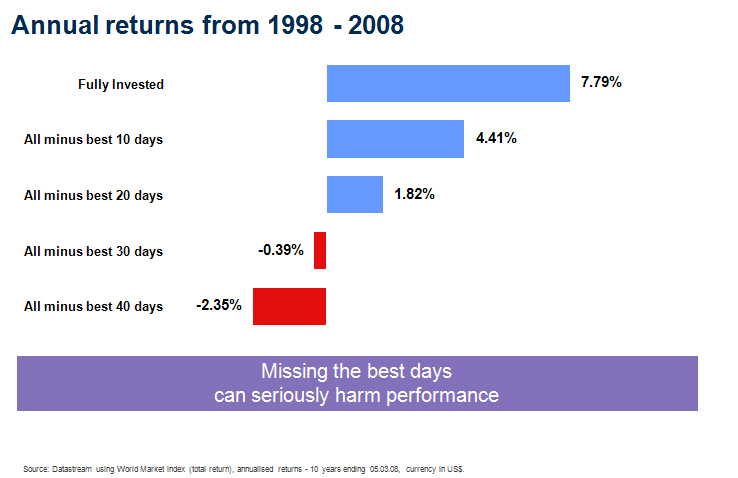
If this graph is my only information, I would definately suggest to put your money in the money market. Please remember that the money market is a short term investment. (So look only at the 2008 portion of this graph)
This graph is fundamentally flawed, as the person who thinks (s)he can time the market, will in most likelyhood also miss some of the worst days of the market.
Your whole idea of money market is wonderful Zam but when is someone likely to move into money market? After the horse has bolted!! All that is going to mean is that they will be tying in their loses, which have already happened! Yes, the markets could move lower and they could be protected from this, however when are they likely to move back into equities? Experience tells one that this will happen only after markets have recovered! So again they will have missed most of the recovery after having tied in their initial loses!
Now remember too that we are making blanket generalisations here and failing to differentiate between recurring (monthly contributions) and lump sum (single contribution) business. Your argument may be slightly more valid when it comes to lump sum business, but again with lump sum business one would normally err on the side of caution. However this thread is about RAs and therefore one would assume it was lump sum business. So now if you are contributing on a monthly basis then a drop in the market should not bother you at all if you are in the portfolio that matches your risk profile (bearing in mind that a major factor in deciding this is term of investment!) as this would mean you would be buying your units at progressively cheaper prices as the markets sinks.
You will find that market confidence ALWAYS only picks up after the markets have recovered! So now you tell me how you are going to time the move back into equities unless you have a crystal ball. You'll miss the boat!
I know words bore some people, so here is another graph to look at which posted before.
A brief explanation :
The orange graphs show movement of funds into bond funds (conservative)
The pink graphs show movement of funds into equity funds (aggressive)
The black bars show the market movements.
If one analyses this you can see that in about Feb 03 when markets were at their absolute lowest people were pumping money into bonds! It was only long after markets started recovering between Feb 03 and Feb 04 that money started flowing into equities. Let me use a nice age old cliche : It is time in the markets, not timing the markets that makes you money!!!
Even Warren Buffet, who knows a lot more about investing than most of us ever will, often uses Wayne Gretsky's, the greatest ice hockey player ever, quote about how he became the best hockey player when referring to investing:
“I skate to where the puck is going to be, not to where it has been.”
Now you are being petty! You did not answer his question (What happened to RAs). You are obviously very quick to jump on the emigrate or shut up bandwagon.
That answer is far from petty and was in fact me being totally honest!
What you need to understand is that RAs are not a type of investment portfolio! They are an investment vehicle via which one can get access to fairly limitless portfolios. So to answer this question would be impossible without analysing the effect of a substantial drop in the Rand across all asset classes, market sectors etc. Now, I could do this, but as stated I really do not think Rwen is interested in that much detail in the answer he seeks. Rwen sings the praises of property but fails to realise that you could have a substantial portion of your RA invested in property portfolios if you desire. As stated you could also have a large portion (now limited though) in offshore portfolios. As much as you wish it would, this question does not have the easy answer you seek!
My opinion, and yes it is just that, is that the whole Zim angle was taken merely as a side swipe at the whole RAs being beneficial argument! If SA goes the way of Zim you will have to worry about every asset you own and not just your RAs. Your RAs are held in funds which are administered by trustees. These trustees have an obligation to protect your retirement savings so they may still well be your most protected asset.