The Isuzu Thread

Isuzu says new D-Max will grab sales from ‘benchmark’ Hilux and Ranger

An Isuzu executive says the new D-Max is a “benchmark vehicle” that will pull sales from segment leaders, the Toyota Hilux and Ford Ranger.

Ben Jaeger, Isuzu Ute Australia's general manager of sales, told CarsGuide.com.au the brand expected the new D-Max to grab a larger slice of the sales pie.

As is the case in South Africa, the Hilux is the best-selling bakkie Down Under, with the Ranger slotting into second place.

“We are moving up in regards to our pricing levels, but we still feel as though we’ll be priced appropriately against the likes of Hilux and Ranger,” Jaeger said, referring specifically to the Australian market.

“We see them as our more natural competitors – they’re obviously the leaders for a reason; they set the benchmark – but we feel as though we’ve got as benchmark vehicle to be able to compete.

 
All-New Isuzu D-Max: More Details

Isuzu will produce the next-generation D-Max in Port Elizabeth from next year and plans to launch the model locally during the 2nd half of 2021. However, the new D-Max, which is also produced in Thailand, has already been released in other markets, which gives us a preview of what the final product will look like.

The Japanese brand recently introduced X-Rider derivatives of the current D-Max in the local market as part of the model’s runout phase. However, in the near future, Isuzu will tool up its Eastern Cape plant as part a R1.2-billion investment programme to produce the next-generation D-Max in Mzansi; it’s expected to generate additional total local content value of R2.8 billion throughout its lifecycle.

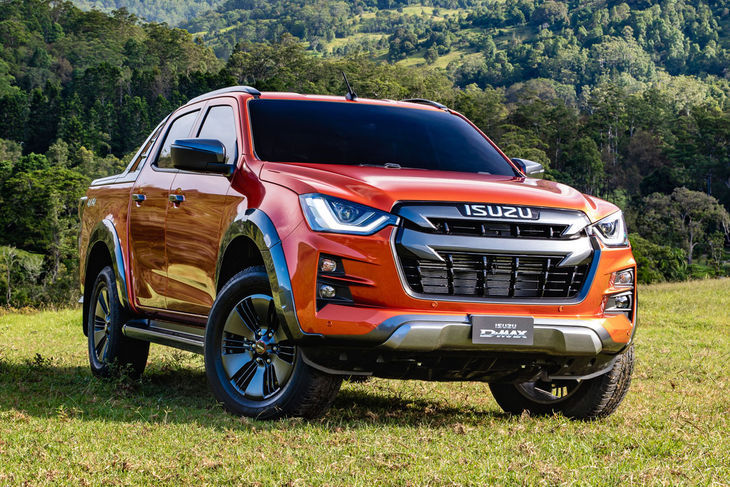
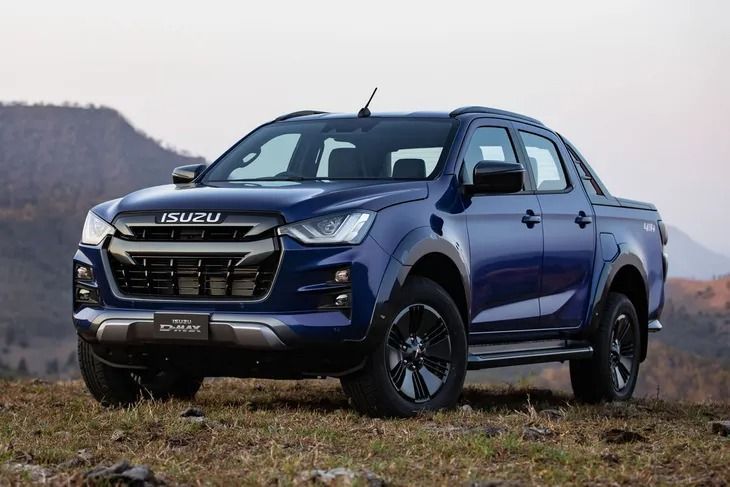
The images that appear in this article depict D-Max's specified for the Australian market, so although the models that will be produced in South Africa will look largely the same as what you see here; their specification will be different – although, to be fair, many of the new model’s improvements will be carried over to SA.

The new D-Max, which underpins the recently-unveiled Mazda BT-50, is wider than its predecessor, with a longer wheelbase and a larger, deeper load tray. Not only is it much more boldly-styled than the current bakkie, it's also sleeker and more aerodynamically efficient. In fact, Isuzu says it has invested 4 million km's of testing and 6 years of development into the model and you can rest assured that a local development programme is, if not already underway, in the offing!

 
Isuzu on new D-Max and Mazda BT-50 twins: ‘two very different brands’

Isuzu says whiles its new D-Max provides a base for the likewise box-fresh Mazda BT-50, the two automakers provide “very different brand propositions”.

Ben Jaeger, Isuzu Ute Australia general manager of sales, told CarsGuide.com.au the two Japanese brands “appeal to very different customer bases”.

“At the end of the day, it’s the elephant in the room, isn’t it? But the reality is that we’ve got two very different brands; two very different brand propositions,” he said.

“Our brands themselves appeal to very different customer bases. We sort of earned our stripes in the commercial space; we’ve got a very, very strong reputation for that,” said Jaeger, .

He added Isuzu’s network coverage Down Under was another “real strength”, before saying the company was “quite rounded in what we can offer up to a variety of customers”, lining up with earlier comments the company planned to pull some private sales from popular rivals such as the Toyota Hilux and Ford Ranger.

 
Isuzu 'investigating' other powertrain options for new D-Max bakkie

An Isuzu executive has revealed the Japanese firm is “investigating” the possibility of adding more powertrain options to its new D-Max line-up.

Isuzu Ute Australia managing director Hiroyasu Sato told CarsGuide.com.au while the company was happy with the updated 3,0-litre turbodiesel unit, it was nevertheless “investigating” the possibility of a “next-generation powertrain”.

Revealed in October 2019, the latest-generation D-Max is powered by a “newly developed” version of the Japanese firm’s familiar 3,0-litre turbodiesel engine, with peak outputs hiked to 140 kW at 3 600 r/min and 450 N.m between 1 600 and 2 600 r/min. An updated 1,9-litre oil-burner with 112 kW and 350 N.m is furthermore offered in some markets.

When asked about the chances of Isuzu offering a hybrid powertrain in future, Sato-san said the firm was monitoring the market closely.

 
Isuzu 'pretty confident' new D-Max will score five-star safety rating

Isuzu in Australia says it’s “pretty confident” the new D-Max will score a five-star safety rating when it undergoes its ANCAP crash test.

Ben Jaeger, Isuzu Ute Australia’s general manager of sales, told CarsGuide.com.au the Japanese firm was “striving for” full marks in the Australasian New Car Assessment Programme (ANCAP) evaluation.

“The previous D-Max had a five-star ANCAP rating but obviously not across the range. And that did put us out of certain bids for certain larger fleet opportunities, so it’s really important for us from a range point of view to get that five-star rating,” Jaeger said.

“That’s definitely what we’re striving for. Of course, we’re not there yet – still got some work to get there – but we’re pretty confident that we’ll [get five stars].”

 
Isuzu D-Max (2021) International Launch Review

We know there's a facelift coming for the market-leading Toyota Hilux, but the most anticipated ALL-NEW bakkie heading for Mzansi is the next-generation Isuzu D-Max. It will go on sale in the 2nd half of 2021, but it's already available in Australia, where our correspondent Matt Campbell has put the newcomer through its paces. How does it compare with the current crop of bakkies in South Africa? Has Isuzu taken a significant step forward? Read on...

First, a disclaimer: the new-generation D-Max that will be sold in South Africa will be built at the Japanese firm's plant in Port Elizabeth and will undergo an extensive local development programme to adapt its powertrain and underpinnings (including suspension tuning) to suit the requirements of the Republic (not least its plethora of road conditions, which range from fine to atrocious, depending on where you're driving). What's more, the units that are sold in Australia are liberally specified, especially with passenger-car-like safety technology. Local units may feature fewer high-end features – and indeed some class-leading considerations – that have been made available in other markets, but it will essentially be the same bakkie, which is why we were keen to find out what it's like to drive.

Summary

All the signs are there that the new-generation D-Max will continue the success story of its predecessor, which certainly has a loyal following in South Africa. The overseas indications are very promising, and if all the hard work that Isuzu has put into making the Australian version as good as it is ends up being carried over to the South African-spec bakkie (which it should, even though local specification has yet to be confirmed), it will no doubt do very well for the brand. If anything, the new model has the potential to grab an ever bigger slice of the lucrative lifestyle market than before.


D-Max 1.jpgD-Max 2.jpgD-Max 3.jpg
 
Watch Isuzu D-Max driver lose control in the wet … and roll bakkie!

This dashcam footage from Thailand shows the driver of an Isuzu D-Max lose control of the vehicle in the wet, before leaving the tarmac and rolling the double-cab bakkie.

Captured in the city of Ayutthaya, the video shows the outgoing D-Max lose grip, seemingly aquaplaning right across the path of the camera-equipped vehicle.

The bakkie then heads off the tarmac sideways, before rolling hard. Here’s hoping nobody was seriously hurt in the crash.


Safest bakkie yet? New Isuzu D-Max scores five-star crash-test rating!

The new Isuzu D-Max has achieved a full five-star rating from the Australasian New Car Assessment Programme (ANCAP), suggesting it's the safest bakkie in its segment.

While the bakkie has already launched in countries such as Thailand, Australia and New Zealand, Isuzu Motors South Africa earlier confirmed local D-Max fans would have to wait until the second half of 2021 to purchase the new-generation, locally built version. Of course, safety specs for the model set to launched in SA have yet to be confirmed.

According to the safety authority, the new D-Max “scored well across all key areas of assessment, with the standard inclusion of a front-row centre airbag for added occupant protection” being a first for the bakkie segment. In that market, the D-Max is furthermore offered with autonomous emergency braking (including pedestrian and cyclist detection), multi-collision braking and active lane-keeping support.

Overall, the D-Max scored 83 percent for adult occupant protection, 89 percent for child-occupant protection, 69 percent for vulnerable road-user protection and 81 percent for its safety assistance technology.


New locally built Isuzu D-Max to gain 'uniquely South African' features

Isuzu Motors South Africa says the new D-Max bakkie set to go into production in Port Elizabeth will boast “some uniquely South African features and characteristics”.

While the new D-Max has already launched in countries such as Thailand, Australia and New Zealand, Isuzu Motors SA earlier said local D-Max fans would have to wait until the second half of 2021 to purchase the new-generation, locally built version. Now, thanks to the impact of the COVID-19 pandemic, it seems the local launch has been pushed back to early 2022.

Still, the Japanese company’s SA arm says “work is underway” on the engineering and testing of D-Max that will eventually be manufactured at its assembly plant in the Eastern Cape.

“The local version will have some uniquely South African features and characteristics,” Isuzu said in a press statement.

Dominic Rimmer, Isuzu SA’s senior-vice president of technical operations, added the new D-Max would be a “significant step forward for Isuzu in all respects”.


Isuzu 1.jpgIsuzu 2.jpgIsuzu 3.jpgIsuzu 4.jpgIsuzu 5.jpgIsuzu 6.jpgIsuzu 7.jpgIsuzu 8.jpgIsuzu 9.jpg
 
Local Isuzu D-Max postponed until 2022

Isuzu South Africa has made it known that the localised version of the Isuzu D-Max bakkie will only be available in 2022.

As one of SA’s three most popular bakkies (Toyota Hilux and Ford Ranger being the other two), the news of an all-new D-Max has provided much excitement for its loyal customers and fans. A new version doesn’t come around very often, with the current generation tracing its introduction back as far as 2011. The new model as already seen sales in major bakkie markets such as Thailand and Australia, but the South African version won’t be available until 2022.

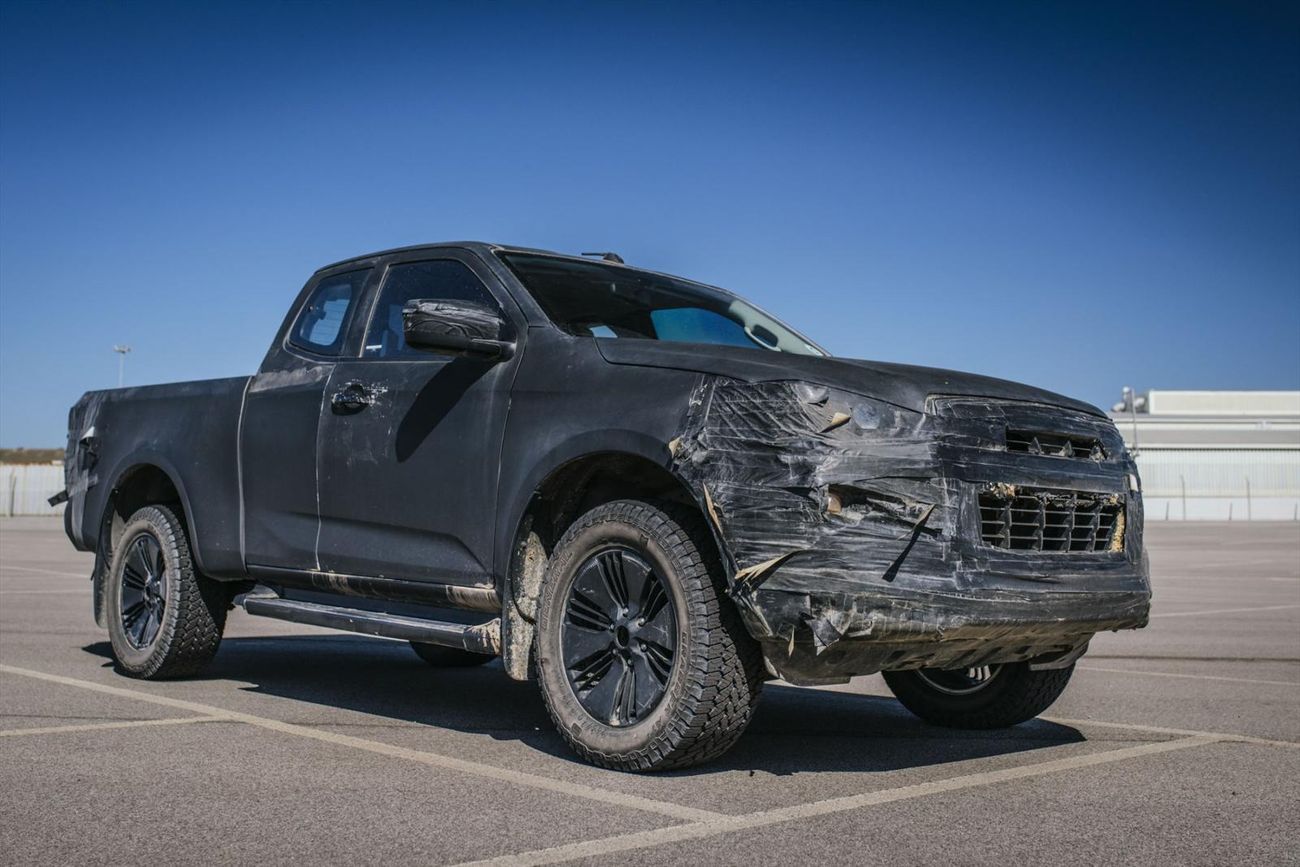
Earlier reports suggested that the D-Max would be available in 2021 but Covid-19 has delayed the local manufacturing facilities upgrades and pushed back the testing of the local unit by more than a few months. Isuzu prides itself on building bakkies for the local market and as such does not import its D-Max but builds it locally in Port Elizabeth after extensively localising the product to endure harsh South African conditions. According to Isuzu SA, “some of the key projects being undertaken include testing on the load box which in the current bakkie has significantly thicker steel in strategic areas such as the load box inner panels, load box front panel, and tailgate.

Other areas receiving attention from local engineers include, dust sealing, suspension tuning and development of local dampers, development of all-terrain tyres, rear differential lock and axles, wiring harnesses, and accessories such as canopies, roll bars and nudge bars.”

As you can see from the images above, local testing has begun so hopefully with a year’s ‘notes’ under the engineers and testing crew's belts, the D-Max fans will still be loyal to the brand.

 
Honda’s original Jazz was once a rugged 4x4 based on an Isuzu

• The Honda Jazz is an important model in the automaker's lineup.

• Honda and Isuzu joined ventures and created the Honda MU-X.

• The rebranded Honda MU-X was sold as a Jazz from 1993-1996.

Jazz by name, KB by nature

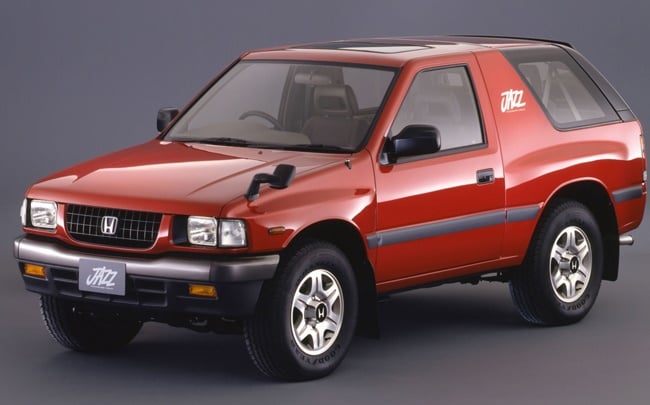
The rebranded Honda MU-X was sold as a Jazz, redating the current compact hatchback nameplate by quite a few years. Although it hardly did stellar volumes in its time on sale (1993-1996), there was nothing mechanically lacking with this rugged Honda Jazz.

Japan is not a motoring landscape given to large SUVs, with narrow streets and ridiculously challenging parking. Honda's product team for the Jazz SUVs cleverly optioned on a three-door configuration, which was Isuzu's slightly shorter first-generation MU-X.

Powering the Honda Jazz 4x4 was Isuzu's 4JG2 turbodiesel engine. It displaced 3 litres among four cylinders and produced 88kW and 270Nm. Those outputs might seem underwhelming now, but in 1993 they were reasonably powerful for a 3-litre engine in a rugged SUV application.

Aware that driving convenience was crucial, the Honda Jazz was configured with a four-speed automatic transmission.

Perhaps the most impressive thing about Honda's Jazz SUV was its enormous range of accessories. However, owners were unlikely to navigate anything approaching a technical off-road route in their three-door Jazz, that did not prevent Honda from offering every conceivable adventure accessory.


Jazz 1.JPGJazz 2.JPG
 
Next-gen (D-Max-based) Isuzu MU-X revealed in fresh patent images

Patent images previewing the design of the next-generation Isuzu MU-X have emerged online, giving us an early look at the new D-Max-based seven-seater SUV.

While Isuzu has yet to confirm when the new MU-X – which will again take on the likes of the Toyota Fortuner, Ford Everest and Mitsubishi Pajero Sport – will hit the road, we’d speculate a reveal is on the cards for some point in 2021.

The next MU-X is expected to borrow the new D-Max’s ladder-frame underpinnings and is also in line to inherit the bakkie’s uprated 3,0-litre turbodiesel engine. In the D-Max, this powerplant generates 140 kW at 3 600 r/min and 450 N.m between 1 600 and 2 600 r/min.

Uncovered by the eagle-eyed folks over at AutoWeek in the Netherlands, the images were recently filed with a Japanese patent office.


Isuzu 1.jpgIsuzu 2.jpgIsuzu 3.jpg
 
Isuzu's D-Max spurs on brand's local sales success

• Isuzu's D-Max bakkie reached a sales target record in August 2020.

• The Japanese manufacturer's local arm builds the D-Max bakkie locally.

• Isuzu CEO Billy Tom says the D-Max was the second best-selling bakkie in May, June and August.

Isuzu Motors South Africa newly appointed CEO and MD Billy Tom said the bakkie and truck manufacturer was well-placed to operate in the current rapidly changing environment despite the impact of Covid-19.

"Given where we have come from, we have a proven track record of resilience which is enabling us to navigate through the current disruptions in our environment. Testament to this is the sales performance which we have delivered over the past few months," Tom said.

 
Top
Sign up to the MyBroadband newsletter
X