


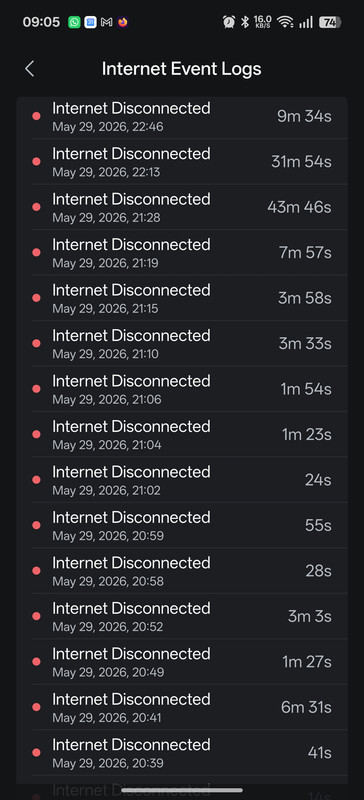
Morning, is this still ongoing? Have you logged a fault? Let me see if we can get some information here.Pretoria, Monument Park side.
South Africa’s biggest forum. Discuss, discover, and connect with thousands of members.
Morning, is this still ongoing? Have you logged a fault? Let me see if we can get some information here.Pretoria, Monument Park side.

Morning! Sorted. Seems like it was an openserve thing.Morning, is this still ongoing? Have you logged a fault? Let me see if we can get some information here.
Good to hear it's stabilised. thanks for the updateMorning! Sorted. Seems like it was an openserve thing.

Howdy, will reach out. First things first, we still allocate public IPs (dynamic or static). There is no reason why you can't have a static IP via the L2TP, which has been tested extensively and runs at 1 Gbps+ without issue. VX has jumbo frame support, so overhead is not an issue. v6 is now native to the L2TP, further simplifying your setup. Alternatively we have a 1:1 NAT option and the 6:4 tunnel which you currently use.Absolutely absurd... Sorry
View Ticket #422372
If I knew I was going to be forced to use CGNAT, I would have moved to a different ISP instead of upgrading a service and giving you more money. Not a happy camper right now. I've had -nothing- bad to say about WebSquad, ever, in the what 8 odd years that I've used you as my ISP.... This, is absurd.
Even *with* the "L2TP tunnel" (which will not give 1Gbps due to overhead), IP now changes on every single reconnect. I've had 1 IP for 8+ years since I've signed up with you.
Even your own IPv6, is now broken and does not work....
Surely there would be overhead on the L2tp if your router port is only 1Gb - so its 1Gb ethernet into ONT plus L2Tp overhead means you will lose some bandwidth to tunnel? I mean if the layer2 is 10gb (or 2.5) - sure then u can get there.Howdy, will reach out. First things first, we still allocate public IPs (dynamic or static). There is no reason why you can't have a static IP via the L2TP, which has been tested extensively and runs at 1 Gbps+ without issue. VX has jumbo frame support, so overhead is not an issue. v6 is now native to the L2TP, further simplifying your setup. Alternatively we have a 1:1 NAT option and the 6:4 tunnel which you currently use.
Regarding the need to go L2TP. VX (Vumatel Trenched) reserves and wastes a large segment of public IPs across their 6 or so master nodes in CPT, similar to how Openserve's IPC used to. The DHCP platform is also incredibly rigid, not allowing for concurrent use of different pools - this means inactive pools churn IPs, and an inability to effectively optimise pool usage across nodes. So the issue comes down to sensible allocation of a limited resource, to ensure you still get a public IP, or wasting resources indefinitely while a poorly designed platform struggles to keep up with the realities of open access networks. Native IPv6 has also only been rolled out for 1 ISP, 6 years after it was promised. VX is not the only FNO on our network, but likes to believe it is. The CGNAT allocation via VX is just to establish a L3 underlay path for the L2TP to connect. From there, you're on a public.
VX is active ethernet and runs jumbo frame, so your L2TP session establishes at a full 1540 bytes (router supporting), delivering a full 1500 byte payload client side. No issues saturating the line at that speed and the overhead is contained by the larger packet.Surely there would be overhead on the L2tp if your router port is only 1Gb - so its 1Gb ethernet into ONT plus L2Tp overhead means you will lose some bandwidth to tunnel? I mean if the layer2 is 10gb (or 2.5) - sure then u can get there.
Would u need to turn jumbo frames on on the router if you are running your own or on the ONTVX is active ethernet and runs jumbo frame, so your L2TP session establishes at a full 1540 bytes (router supporting), delivering a full 1500 byte payload client side. No issues saturating the line at that speed and the overhead is contained by the larger packet.
PPPOE on a 1500 byte ethernet frame has an 8/20 byte pppoe header, payload 1492/1480 bytes. So in theory, PPPOE has a larger overhead here.
Openserve use something similar on their LNS network, stripping the PPPOE, encapsulating in L2TP and delivering a 1548 byte frame to the ISP. Once the L2TP layer is stripped, we receive the original 1492/1480 PPPOE payload.
So for VX, router supporting, we get a full frame 1500 byte client payload, or worst case 1460 (2.6% header which is incrementally more than a PPPOE).
You would just need to enable this at a router. VX CPE is already jumbo.Would u need to turn jumbo frames on on the router if you are running your own or on the ONT
Evening, sounds like something funky on your line there. Have you logged a ticket for our team to escalate to Evotel?Anyone having upload issues? Getting 0.84Mbps upload on my 850/850 evotel @websquadza are there any known issues? Download is fine..
Thanks for the late reply. I was going to but then I got normal speeds for a bit but the issue has returned so I have logged a ticket nowEvening, sounds like something funky on your line there. Have you logged a ticket for our team to escalate to Evotel?

Hi there, thank you for bringing this to my attention. I've flagged it with the accounts team. They will follow up shortly.Hi @websquadza
Please look into the following invoice for R1099, dated 26 June 2026.
#368516.
Invoiced for 250/250 but as per the following downgrade ticket, my speeds won’t be 250/250
#370333

Hi, any update on this?Hi there, thank you for bringing this to my attention. I've flagged it with the accounts team. They will follow up shortly.
Checking in, I see you ordered an upgrade (might have my strings crossed here)?doesn’t seem too bad for Gigabit … they should’ve come in with some undercutting prices to lure some of us

Checking in, I see you ordered an upgrade (might have my strings crossed here)?