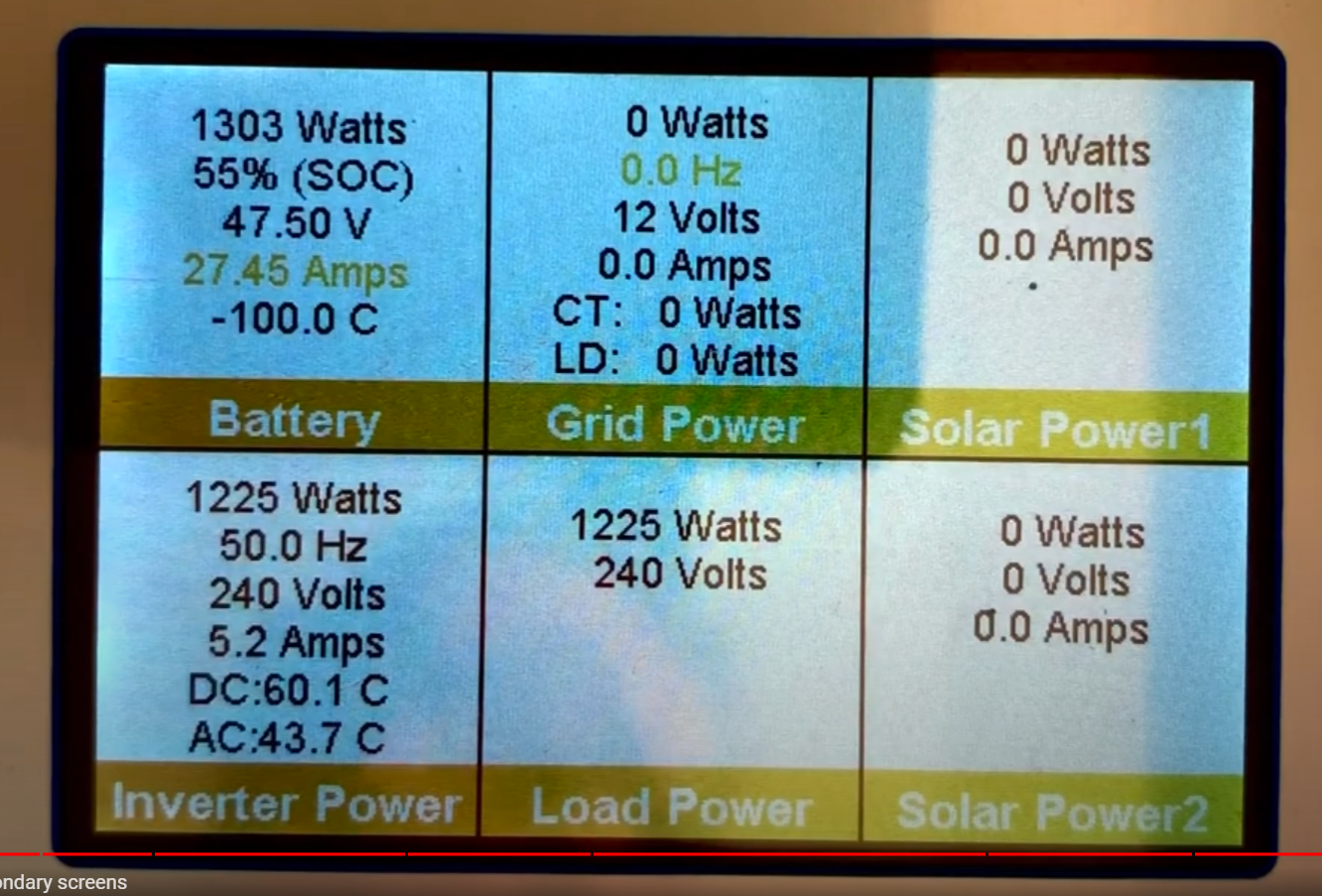
All things Sunsynk (Deye, Inge, etc...)

Well, I just learned something new!
Called the best solar installers in town, the guy explained it quite nice and simple.

He has the Deye installed at his place and tested it. It blends great on a 5KW inverter, with the battery set to 60%, they geyser will heat from the battery then use Eskom if available.

Requesting a quote on 8x Canadian 455W panels with installation.
Their rough estimated install came to R20k over the phone, I hope that's not right. Seems heavy!

The Canadian 455W panels were priced R3500 on the mark.
If the install includes the hardware to mount, wiring and switch gear, then it is probably good.
 
Can one connect an oldish petrol generator to a 5kw Deye in order to charge the batteries? Any guidance with regards to setup would be appreciated.
 
Can one connect an oldish petrol generator to a 5kw Deye in order to charge the batteries? Any guidance with regards to setup would be appreciated.
In theory no reason why not, that's why the have a aux port. Most installers I spoke to don't like the idea though.
 
Arb question, if I use a constant 2kw per hour for 2 hours ( so in theory 4kwh ) or 4kw in one hour , its the same in the end in kwh?
 
In theory no reason why not, that's why the have a aux port. Most installers I spoke to don't like the idea though.
Only because most people don't connect the generator properly through a changeover...
 
Can one connect an oldish petrol generator to a 5kw Deye in order to charge the batteries? Any guidance with regards to setup would be appreciated.
I have an inverter generator connected to my aux port that I run when my batteries are running low and eskom has been down for extended period/poor sunshine.

Firstly your generator needs to be big enough to cover your base load, and then have spare power to charge the batteries.

Connect the generator to the aux port.
On the aux menu of inverter, select generator mode and enter in a power value that your generator can safely provide.
Under batteries menu, there's a generator section, select the max charge value you want to charge the batteries with the generator.
Select the Gen signal boxes.
Make sure your work modes have Gen charge ticked for the correct time periods and also the correct battery charge percentages.

That should be it.
Once the generator is running it won't pickup instantly.
The relay operates every minute or so to detect.
The front of the screen will also show a generator when it wants it to turn on.

Edit: People have a lot of issues with non-inverter generators and sometimes you might need to adjust your throttle to stabilize the frequency provided.
Also need to make sure you don't have floating neutral.

Heres more info that might help:
 
Last edited:
Arb question, if I use a constant 2kw per hour for 2 hours ( so in theory 4kwh ) or 4kw in one hour , its the same in the end in kwh?
Firstly, toss the concept of kW per hour and then secondly, yup. Also, using 8kw for 30 mins or 1kw for 4 hours all end up at the same 4kWh.
 
Last edited:
Tried a 6.5kva on my 8kw SynSynk once. Even lowered the draw to 1000w and it refused to accept the power. The problem is petrol generators need to ramp up their revs when they detect load and that gap is what the inverters don't like.

Spoken to a few installers and they recommend a diesel generator rather.
 
Tried a 6.5kva on my 8kw SynSynk once. Even lowered the draw to 1000w and it refused to accept the power. The problem is petrol generators need to ramp up their revs when they detect load and that gap is what the inverters don't like.

Spoken to a few installers and they recommend a diesel generator rather.
My 4kva inverter generator connected first time without issues.
If you don't need a diesel sized generator, then there are alternatives that will be cheaper.
But if you can get a generator supporting ATS, then your life will be much easier than the manual connections I have to do now
 
Hi all, I've had my Deye 8kw inverter and batteries for a while now and only recently got the solar panels installed.

With the panels installed I am now trying to get the best benefit out of them but am encountering some oddities which hopefully someone with more experience is familiar with:

1. I have zero export to CT enabled so that the Solar can push back to the non-essentials during the day, however any shortfall is covered by the battery instead of the grid. Is this normal behaviour?
2. Is the time-of-use schedule ignored during an outage/loadshedding? (Currently using time-of-use schedule with a high SOC level during the expected Stove/Oven period to prevent non-essentials using batteries but then I lose the benefit of using batteries for the essentials)
3. Is there a simple way to automate/schedule "limit to load" (I assume I would solve problem 1 & 2 by switching this off/on during the day/night)

Still a newbie to this so would appreciate any thoughts on this.
 
Can one connect an oldish petrol generator to a 5kw Deye in order to charge the batteries? Any guidance with regards to setup would be appreciated.
You can but it is not easy to get right.

These inverters are immensely fussy about the frequency that gets fed to them and the mechanical governer is just too slow ( by a few microseconds) in reacting to loads and being unloaded.
That's where inverter generators have the edge I think.

What eventually worked for me, after a lot of fiddling and adjustment, was to scale back the battery charging ( I think I made it about 10/15A ) and just let it run the load for nighttime.
During the day when the houses loads are more stable I can ramp the battery charging up much higher.
 
Hi all, I've had my Deye 8kw inverter and batteries for a while now and only recently got the solar panels installed.

With the panels installed I am now trying to get the best benefit out of them but am encountering some oddities which hopefully someone with more experience is familiar with:

1. I have zero export to CT enabled so that the Solar can push back to the non-essentials during the day, however any shortfall is covered by the battery instead of the grid. Is this normal behaviour?
2. Is the time-of-use schedule ignored during an outage/loadshedding? (Currently using time-of-use schedule with a high SOC level during the expected Stove/Oven period to prevent non-essentials using batteries but then I lose the benefit of using batteries for the essentials)
3. Is there a simple way to automate/schedule "limit to load" (I assume I would solve problem 1 & 2 by switching this off/on during the day/night)

Still a newbie to this so would appreciate any thoughts on this.
1. Yes. It's zero export of all power, not just pv. Use timers on your geyser.
2. Yeah it's ignored and would discharge to the shutdown level set in your battery menu. But when there's load shedding your non-essentials go down too so no need to worry about them drawing power.
3. You could probably automate it via home assistant...
 
I have an inverter generator connected to my aux port that I run when my batteries are running low and eskom has been down for extended period/poor sunshine.

Firstly your generator needs to be big enough to cover your base load, and then have spare power to charge the batteries.

Connect the generator to the aux port.
On the aux menu of inverter, select generator mode and enter in a power value that your generator can safely provide.
Under batteries menu, there's a generator section, select the max charge value you want to charge the batteries with the generator.
Select the Gen signal boxes.
Make sure your work modes have Gen charge ticked for the correct time periods and also the correct battery charge percentages.

That should be it.
Once the generator is running it won't pickup instantly.
The relay operates every minute or so to detect.
The front of the screen will also show a generator when it wants it to turn on.

Edit: People have a lot of issues with non-inverter generators and sometimes you might need to adjust your throttle to stabilize the frequency provided.
Also need to make sure you don't have floating neutral.

Heres more info that might help:
Thank you for the detailed response. Appreciate!
 
Changing to a smaller element cuts down peak load, but still uses the same amount of energy to heat the water. I don't believe the PTC marketing - will need some independent testing before I believe the snake oil.

Also, splitting the system makes no sense. Just put everything on essentials and a smart switch on the geyser to turn off when there's load shedding and insufficient PV. Simpler is better.
Wire the geyser to the Aux port. Chose aux load output. Toggle on grid always on. Configure the on and off battery percentage. You can leave Solar power to 0 if you need it to be able to run at night when no grid and battery conditions on met, or set minimum Solar requirements. Have setup a 3kw Geyser like this on a 5kW inverter and it works perfectly.
 
Top
Sign up to the MyBroadband newsletter
X