El-Cheapo UPS Battery replacement: Can I use Lithium (LiPo)?

Ja I cant see many alarm system chargers being able to take one of these batteries as a simple drop-in replacement without giving problems.
Nor gate motors

With LS going on the batteries will discharge slowly not top up and then simply stop working.
 
The next problem is the minimum voltage for reliable working which according to the spec is 11.6V. so, unless the UPS keeps the voltage above that level before it cuts out, or you can adjust it to cut out above 11.6 V the UPS will not start up again, as the battery will run down to 10.9 and then will have to be disconnected and reconnected.

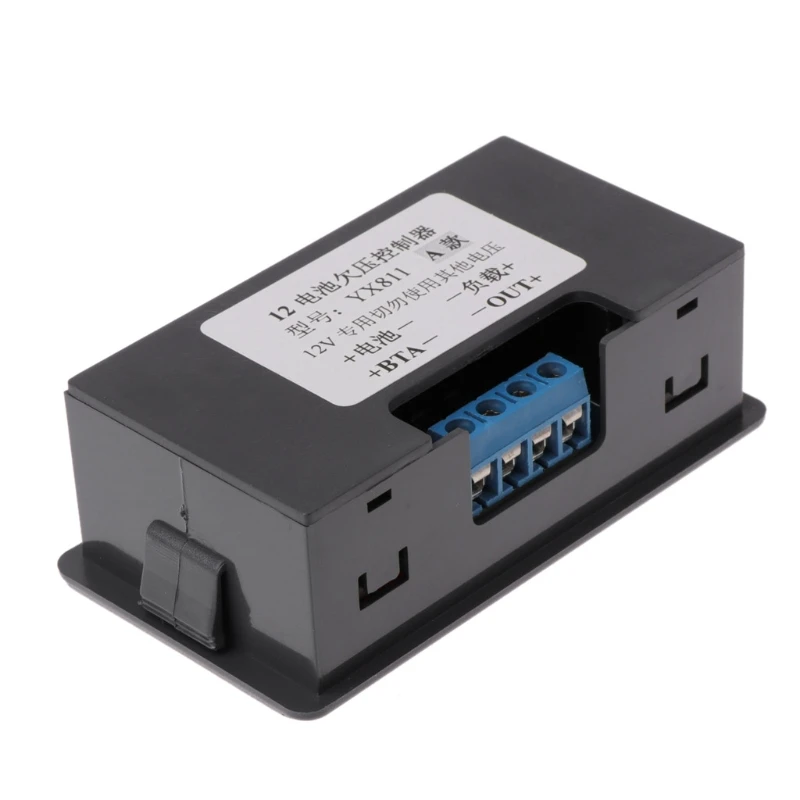
You do get little black box thingies that you can set to cut out at any voltage, which would obviate this problem.

I have a Kemo M148A Battery Guard, can set cut-off to 10.4 to 13.3 volts. This one handles up to 20A with cooling, or 10A without cooling.

 
You do get little black box thingies that you can set to cut out at any voltage, which would obviate this problem.

I have a Kemo M148A Battery Guard, can set cut-off to 10.4 to 13.3 volts. This one handles up to 20A with cooling, or 10A without cooling.

Good point and post thanks. An external added semi BMS setup will work between the UPS output and the battery.
 
You do get little black box thingies that you can set to cut out at any voltage, which would obviate this problem.

I have a Kemo M148A Battery Guard, can set cut-off to 10.4 to 13.3 volts. This one handles up to 20A with cooling, or 10A without cooling.

So let me see if I understand this.

You put one of these gadgets in line when you replace the lead acid batteries in your UPS with lithium ones, and then everything works fine? I must be missing something.
 
So let me see if I understand this.

You put one of these gadgets in line when you replace the lead acid batteries in your UPS with lithium ones, and then everything works fine? I must be missing something.

Yes, you can make the current flow from the battery cut out at the optimal level for the lithium battery.

BTW, it can also be use to protect lead-acid batteries from going too low, and thereby protect them.

I have one in my car in order to ensure that the fridge doesn't take the voltage too low, and thereby ensure that the car can always still start.

But there is still the issue of whether the charging circuit in the UPS is optimal for the lithium battery. But this is a common problem, lead-acid, AGM, lead-crystal and lithium batteries all have different charging profiles.

The gadget does however ensure that the lithium battery voltage doesn't go too low. Read the link that I gave.

There are different brands of these gadgets, I also have some others.

Another example :


Some of the car fridges and other devices, as well as UPS's, have built-in cut-offs, but they invariably cut off at too low voltages, thereby causing damage to the batteries. One of these gadgets will protect your batteries.
 
Last edited:
Yes, you can make the current flow from the battery cut out at the optimal level for the lithium battery.

BTW, it can also be use to protect lead-acid batteries from going too low, and thereby protect them.

I have one in my car in order to ensure that the fridge doesn't take the voltage too low, and thereby ensure that the car can always still start.

But there is still the issue of whether the charging circuit in the UPS is optimal for the lithium battery. But this is a common problem, lead-acid, AGM, lead-crystal and lithium batteries all have different charging profiles.

The gadget does however ensure that the lithium battery voltage doesn't go too low. Read the link that I gave.

There are different brands of these gadgets, I also have some others.

Another example :


Some of the car fridges and other devices, as well as UPS's, have built-in cut-offs, but they invariably cut off at too low voltages, thereby causing damage to the batteries. One of these gadgets will protect your batteries.
Thanks for the explanation.

From what I understood though, a lithium battery with a BMS doesn't require really complicated charging circuitry, you just need sufficient voltage to get the cells to balance. A friend of mine who is into ebikes just charges his homebrew battery with a bench power supply set to the right voltage with a current limit. So initially the battery draws the max current (constant current charging stage) which invariably pulls the voltage down, and then once it gets enough juice the current drops and then the voltage stays more or less constant for the next stage of charging.

What will a UPS designed for lead acid batteries do that a simple bench power supply won't? Do lead batteries need a more complicated charging profile?
 
Well, have had 2 x Blue Nova BN13V-8-104Wh in my Eaton 5E 1500VA UPS for the past week now, so far so good.

Connected a Blue Nova BN13V-11-140Wh to my electric fence energiser as well, since the 12ah lead acid had died the week before.
 
Looking to replace my gate motors with these. Will be watching this thread.
 
The intelligent chargers (eg CTEK, Victron, some Chinese chargers, etc) have a sophisticated charge profile, and switch to a trickle charge when the battery is fully charged. The bench power supply won't do that, and you can overcharge the battery, causing damage.

The chargers built into the UPS's, etc, are not as sophisticated as a CTEK, but mostly do a reasonable job.
 
Thanks for the explanation.

From what I understood though, a lithium battery with a BMS doesn't require really complicated charging circuitry, you just need sufficient voltage to get the cells to balance. A friend of mine who is into ebikes just charges his homebrew battery with a bench power supply set to the right voltage with a current limit. So initially the battery draws the max current (constant current charging stage) which invariably pulls the voltage down, and then once it gets enough juice the current drops and then the voltage stays more or less constant for the next stage of charging.

What will a UPS designed for lead acid batteries do that a simple bench power supply won't? Do lead batteries need a more complicated charging profile?
It is about exactly those two parameters, current and voltage.
A bench supply has settings which you control.
A UPS has a processor that has predetermined what these settings are.
Next, a UPS is NOT a backup power supply UNLESS it designed to be one. So, you have to know what type of UPS you have. Is it designed to provide power for a limited period before shutting down, 15 - 20 minutes, then the UPS will not run the battery flat and the drop-in replacement may work.
If the UPS is also a backup power supply, then, it depends entirely on what the built-in charging profile is, or, if you as a user can change the settings if need be.


If the charger is nothing more than a trickle charger, then the charger is designed to limit the charging current which means a battery will take a long time to charge.
If the charger circuit is designed to optimally charge a LA battery according to a pre-determined charging profile, then it means the Li battery's BMS will probably be able to handle that profile quite well.

Now what happens when the Inverter kicks in when the power fails?
A UPS designed for LA batteries will typically allow the voltage on the battery to fall below 11.4V and go as low as 10.8 V which means a Li battery will be driven too low and not recover when the power comes back without going through a setup process which mostly involves disconnecting the battery when the power comes back and allowing the charger to reach operating Voltage, then re-connecting the battery and then it will charge again.

Again, it is about the specific design of the UPS.

So good luck to those that are doing this drop-in exercise, keep us posted of what happens after a protracted period of Load Shedding and the battery discharges too low. Lets us then hear from you if the battery automatically recovers or not.
 
Looking to replace my gate motors with these. Will be watching this thread.
Dont wait fo some or other vague comment on a public forum. Go and ask your gate motor supplier now if he thinks his gate motor will be able to accept a drop-in Li replacement battery.

Centurion Gate Motor has already informed me that my old gate motor model will NOT be able to charge a Li battery properly under severe LS conditions and advises against the use of the Blue Nova batteries.

I have checked my Alarm system power supply, and it will NOT recover from an extended outage due to LS because the design allows a battery to discharge to 10.8V and have a fancy charging circuit, and is a trickle charger only.
 
I installed lead-crystal batteries into my Hansa gate motor a year or two ago, those have worked remarkably well.

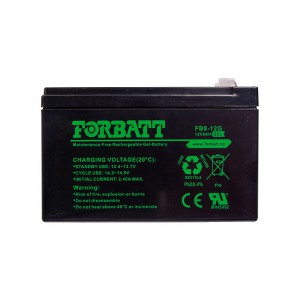
I don't seem to be able to get those LC batteries any more, so am now playing with gel batteries :


So far so good. I have installed those in my alarm system.

I am using a lot of 18650 lithium batteries for various devices, and have proper chargers for those.

I would love to start using larger lithium batteries for various devices (UPS, battery box, gate motor, alarm system, etc), but I am waiting for the chargers etc to catch up.
 
Dont wait fo some or other vague comment on a public forum. Go and ask your gate motor supplier now if he thinks his gate motor will be able to accept a drop-in Li replacement battery.

Centurion Gate Motor has already informed me that my old gate motor model will NOT be able to charge a Li battery properly under severe LS conditions and advises against the use of the Blue Nova batteries.

I have checked my Alarm system power supply, and it will NOT recover from an extended outage due to LS because the design allows a battery to discharge to 10.8V and have a fancy charging circuit, and is a trickle charger only.
I did ask Centurion and they said it would work fine. I think they were only looking at the battery size.
Blue Nova as just a bit misleading on drop-in replacement if you can't just drop it in.
 
Here is the Blue Nove spec sheet for anyone interested. Would love to see what others think about the cycle life specs and what the values mean.

The battery is nominal 13V, 8AH, 104Wh - energy capacity.

8AH implies a C-rate of 8A for 1 hour = 1C ( the specs talks about C1)

If that is correct, then what does C10 mean????
 

Attachments

Here is the Blue Nove spec sheet for anyone interested. Would love to see what others think about the cycle life specs and what the values mean.

The battery is nominal 13V, 8AH, 104Wh - energy capacity.

8AH implies a C-rate of 8A for 1 hour = 1C ( the specs talks about C1)

If that is correct, then what does C10 mean????

They mean C/10 which is 0.8A
 
Here is the Blue Nove spec sheet for anyone interested. Would love to see what others think about the cycle life specs and what the values mean.

The battery is nominal 13V, 8AH, 104Wh - energy capacity.

8AH implies a C-rate of 8A for 1 hour = 1C ( the specs talks about C1)

If that is correct, then what does C10 mean????

2000 cycles (aka when it reaches 80% of original charge capacity) at 100% DoD? Love it. Better than a 9ah SLA that can handle how many 100% DoDs and still be decent?
 
They mean C/10 which is 0.8A
Yes correct . you have to divide the C Rate by the number behind the "C" to determine under what conditions the cycle life calculation/test, or spec sheet entry is valid.
 
Last edited:
If the charger is nothing more than a trickle charger, then the charger is designed to limit the charging current which means a battery will take a long time to charge.
If the charger circuit is designed to optimally charge a LA battery according to a pre-determined charging profile, then it means the Li battery's BMS will probably be able to handle that profile quite well.
I've got this RCT-650VA, which mentions: "Fast charging in 4 hours" - hopefully that means it'll cope with one of these 'drop-in-replacements'

My RCT battery was replaced under warranty, so I don't need the BlueNova just yet. If I get one, I'll monitor voltage and recovery capability and post an update here.
 
I just cracked open a 2000VA RCT UPS and found two really crappy 12V 4Ah batteries in there.

I replaced those batteries with 12V 8Ah lead crystal batteries, will be interesting to see how it performs now.

Seems that these guys try to save a bit on batteries.

But to RCT's credit, the rest of the insides looked well designed and constructed.
 
Thanks for the explanation.

From what I understood though, a lithium battery with a BMS doesn't require really complicated charging circuitry, you just need sufficient voltage to get the cells to balance. A friend of mine who is into ebikes just charges his homebrew battery with a bench power supply set to the right voltage with a current limit. So initially the battery draws the max current (constant current charging stage) which invariably pulls the voltage down, and then once it gets enough juice the current drops and then the voltage stays more or less constant for the next stage of charging.

What will a UPS designed for lead acid batteries do that a simple bench power supply won't? Do lead batteries need a more complicated charging profile?

Yes, Lead Acid charging is complicated.

Lithium based is far simpler - feed me power till I reach a certain voltage, then taper off.
The BMS on the "12v Lithium Battery" would handle that anyway, as it needs to balance the individual cells in the larger "battery".

Depending on chemistry, the individual cells could be anywhere from 3 - 4 volts.

LFP cells usually lie about 3.3v nominal. (LiFePO4)

For 12v, you'll have 4 in series, so your 12v will sit at about 13.2v (3.3v x 4)
Discharged will go to about 10v (2.5v x 4) before they die, and full will sit at about 14.4v (3.6v x 4)

LFP are the safety chemistry to use, although not as dense as other Lithium chemistries - Lithium Polymer (LiPO) is the densest, but also the most unsafe.

Most of the batteries in Solar appear to be LFP, or NMC (Lithium Nickel Manganese Cobalt Oxide), which is denser - i.e. more power available for the weight, albeit at a higher cost of manufacture. Tesla uses NMC.
Most of the Chinese brands use LFP.
 
Top
Sign up to the MyBroadband newsletter
X