New The PC Build Thread

Personal choice. Either is fine. Not being very technical inclined I let titan ice build my systems or install my components.
Just easier for me personally.
I've been looking at the Wootware Builder to put together the components I want. How do I configure a PC on the Titan Ice site? I don't want an all-in-one or a gaming PC. I already have a graphics card and hard drives so I want a minimal build, using an Intel 14400 and DDR4 RAM. None of the upgrade kits match that.
Should I contact them directly?
Thanks!
 
I've been looking at the Wootware Builder to put together the components I want. How do I configure a PC on the Titan Ice site? I don't want an all-in-one or a gaming PC. I already have a graphics card and hard drives so I want a minimal build, using an Intel 14400 and DDR4 RAM. None of the upgrade kits match that.
Should I contact them directly?
Thanks!
If you know what components you want just add them plus basic assembly to your cart.


Or contact them directly tomorrow morning. They respond fastest on the wa nr.
 
yeah, im also using WW PC Builder and have all components selected but no motherboard option for AMD Ryzen 7 9700X can any of you kindly advise on a mb for this chip
 
yeah, im also using WW PC Builder and have all components selected but no motherboard option for AMD Ryzen 7 9700X can any of you kindly advise on a mb for this chip
A B650 chipset board is more than capable for even a 9800x3d cpu (just make sure it atleast has some decent cooling onthe VRM's).

It all depends on what i/o you want on the back of it and how many nvme slots. The newer boards have the fancy ports which a lot of people will never use anyway.

Keep in mind, too many nvme slots eat into the pcie express x16 slot's speed, dropping it to x8. Each board has a different config so you need to check the manual which slot to avoid using to prevent the drop to x8 speed
 
I use 9950x on my b650 msi, it does 2x8pin and decent vrm, i also gets full speed on my gen 5 nvme even know its only advertised to have gen 4 nvme support.
 
dumb Q! is it best to run this chip(ryzen 7 9700X) with dual channel RAM or can I get away with a single ddr5 module
You could, but you shouldn't. Get 2 sticks cause you'll lose a lot of performance
 
Hardware Unboxed has a video overview of a range of budget B650 boards and they found that most of them have crap vrms that a 7950x will melt, so be careful. (Melt is an exaggeration, it will throttle, but you get the idea).
 
I have twice typed a post on this, but also deleted it twice prior to posting. Since I want to avoid technicalities, and not all AMD GPUOpen documents are public.

For now, we know that FSR 4 is dependent on FP8 WMMA. It is not known whether it needs other instructions or libraries. Documentation supports that the RDNA 3 architecture can do FP16, BF16, IU8 (8-bit integer) and IU4 (4-bit integer) datatypes. Not going into the technicalities, but WMMA is available in the rocWMMA library.

This library is portable with nvcuda::wwma and it support MFMA and WMMA instructions. This is applicable to RDNA 3 and CDNA 1 and 2.

Everything can be read here: https://gpuopen.com/learn/wmma_on_rdna3/

RDNA 3, unlike RDNA 2 and 1, has AI Accelerators. It is not like Nvidia, which has Tensor cores that are dedicated, and CUDA cores that are dedicated. The AI Accelerators, however, are not dedicated and have to do other computational tasks.

This is something many here should know already. CDNA, unlike RDNA, has Matrix Cores, that is dedicated. Trying to keep this short. FP8 instructions were introduced to MI300, well, GFX940. RDNA 3 is GFX11xx and RDNA 4 is GFX12xx. Way too many numbers, but codes, compilers and so on, are written. All that remains is optimization. Some think that AMD is not doing its best at this, but that is what it is.

I typed all this to get back to FSR 4. The word is that FSR 4 will not be available on RDNA 3 because RDN A3 does not have native FP8 WMMA. It is too early to say, but RDNA4 does support new libraries that have been introduced in CDNA3. FSR4 was likely developed on CDNA 3. Backporting is the wrong word, though some would say that FSR 4 could be backported to RDNA3, but with limited capabilities. Well FP8 -> FP16. Later FSR iterations could move to other instructions or back to FP16 depending on how well utilization is optimised. Could FP8 WMMA be emulated on RDNA 3, possible, but emulation is a resource hog, again, optmisation.

Why do I type all this, well, it is a bore to read documentation, but FSR 4 is theoretically possible on RDNA3, and RDNA3 at the top-end has the RAM. Will AMD dedicate resources to this... dunno. FSR 4 on the 7900 series cards could put the 9070, results pending, in bad light. It is without a doubt that FP8 WMMA, its 'magic', that essentially is a lower precision data type than FP16 will be called AI. AI and its revolutionary tricks.

This begs the question, can "AI" bring FSR 4 to RDNA3? Though this depends on FSR 4 dependencies that are not all yet known. There is a reason why AMD doesn't have a new driver out other than a preview, which usually showcases its new beta things. The answer is: It's possible. RocWMMA and other hardware-accelerated applications/instructions have shown improvements. Slow, but steady strides.

The problem that buyers might have is that RDNA 4 is the last bridge to cross to UDNA. Back to the GCN days. UDNA will be as dedicated as CDNA, since well, it is CDNA and RDNA in one.

Anyway, it is an old LLVM examination:


and we don't actually know what RDNA 4 looks like, architecturally, until it is released with its documentation.

All that can be said now is that RDNA 3 and older... eh. Support will slow down. Nvidia is beating AMD at long-term support. Though AMD, is understandably making radical architectural changes. Not all hope is lost. AMD is pursuing to querying the market to bring ROCm, updated, to older GPUs to enable them "AI" capabilities, and this could include GCN, well, Vega, not older, and some think that HBM2 can still do some new tricks. Frontier cards had 16GB RAM and so did VII.

So RAM. By now gamers should know why 12-16GB is a 'consumer' limit, unless you go halo class. It is because they don't consumer products to be bought by their commercial customers.

Anyhow, long post. TLDR, FSR 4 is technically possible on RDNA 3 (at the high end). Who knows. Marketing and technical teams... You know, AMD wants to sell new GPUs.
 
Frank Azor is all in on RDNA 4 marketing. He posted this:


I assume that the AI Accelerators are still shared. No Matrix Cores, otherwise that would have been the headline. UDNA is where it will be at a consumer level.

Whatever is new in these generations will be up to the documentation. In the case of RDNA 3, every compute unit is equipped with one ray tracing accelerator. "Optimised" compute units are probably the "Bug Fix" they were talking about.

Generally, I think this will be a good GPU, but it will only be as good as its price. My expectations, however, aren't high. CDNA is not doing well in sales, well, they are below expectations. I haven't trusted AMD GPU marketing since Vega.

Anyway, not going to say anything more on this. Early March they said. There is the odd chance that this will be more or less the same as Nvidia's RTX 5000 launch. Everyone who has an RX 7000 will still be okay. Just watch, there will be stack adoption.

I can't wait to see the 9900/50X3D though.

Lol, though,

 
Id understand if AMD goes the way of the 50 series and take a minor upgrade.

There is so much happening in the GPU market at the moment they probably need to rethink many things.
 

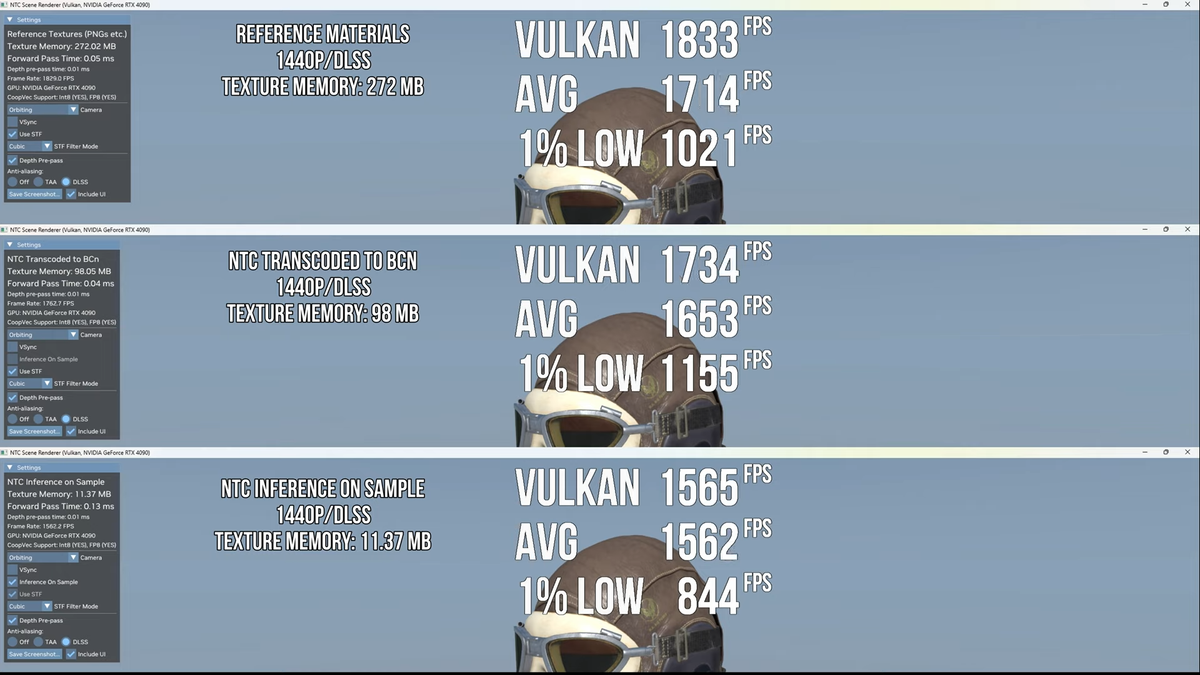
Nvidia's new tech reduces VRAM usage by up to 96% in beta demo — RTX Neural Texture Compression looks impressive​


Impressive, indeed, if the demo is anything to go by. There is minor impact on performance. Just for notice:

The technology is in beta, and there's no release date. Interestingly, the minimum requirements for NTC appear to be surprisingly low. Nvidia's GitHub page for RTX NTC confirms that the minimum GPU requirement is an RTX 20-series GPU. Still, the tech has also been validated to work on GTX 10 series GPUs, AMD Radeon RX 6000 series GPUs, and Arc A-series GPUs, suggesting we could see the technology go mainstream on non-RTX GPUs and even consoles.
 
For those with current-generation GPUs, I don't know who has watched this Digital Foundry video.


Touching on my above post, as noted, this technology will work on any GPU with Shader Model 6, pending support. Now, AMD has something similar, and having a different approach, that they announced on the 6th,


Solving the Dense Geometry Problem​

Problem: Increasing Triangle Density​

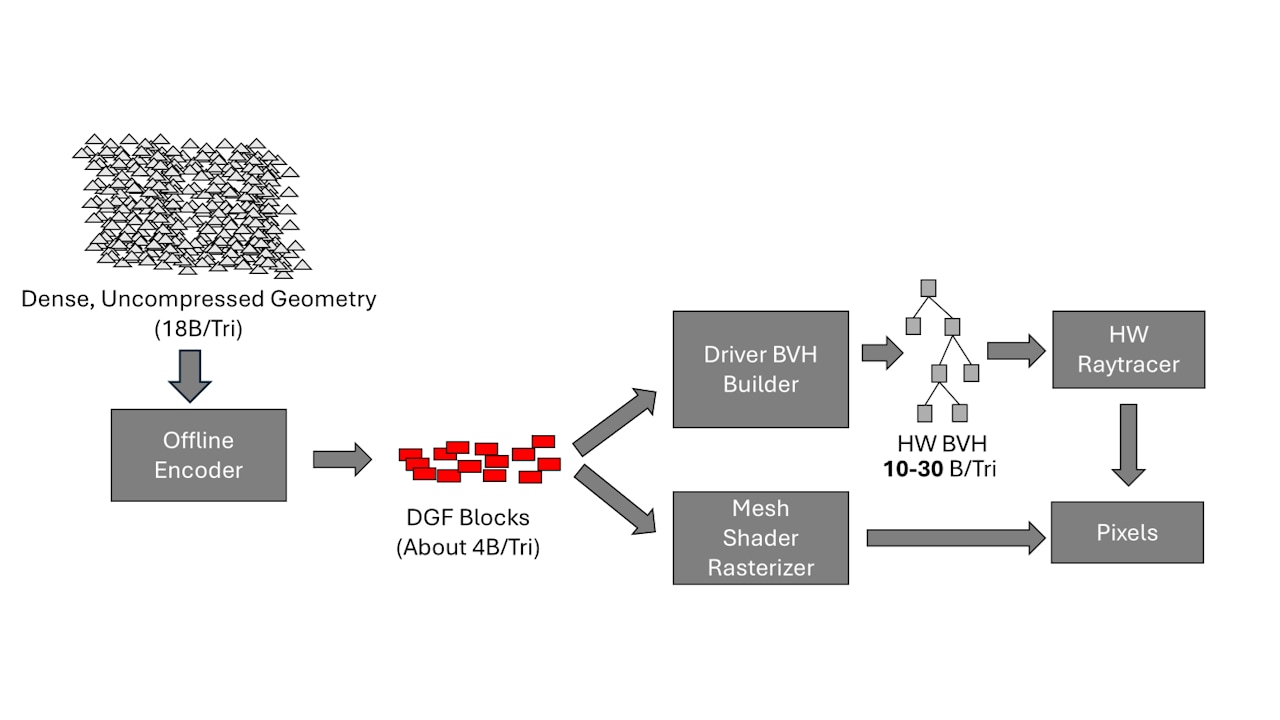
Historically in graphics we’ve stored triangle data in memory as vertex and index buffers, sent it to a hardware rasterizer, and produced pixels. A few years ago, we added raytracing to the pipeline, so now we pass our meshes through driver routines, which produce vendor-specific acceleration structures that the hardware can consume.

In the same timeframe, technologies like Nanite have raised the bar for model complexity, by introducing very small triangle formats which are directly rasterized, in some cases using software rasterization in compute shaders. Systems like these create challenges for ray tracing.

A custom compression format can’t be consumed directly by the current raytracing API. Instead, we need to decode it into something which the APIs understand. This increases memory pressure and adds latency to the BVH build, both of which can lead to unstable, stuttery frame rates. Even if the API restrictions were lifted, the existing hardware acceleration structures are much too large to support future content, which will be authored with the lower data rates in mind.

Solution: Hardware Geometry Compression​

Dense Geometry Format (DGF) is a block-based geometry compression technology developed by AMD, which will be directly supported by future GPU architectures. It aims to solve these problems by doing for geometry data what formats like DXT, ETC and ASTC have done for texture data.

DGF is engineered to meet the needs of hardware by packing as many triangles as possible into a cache aligned structure. This enables a triangle to be retrieved using one memory transaction, which is an essential property for ray tracing, and also highly desirable for rasterization.

By moving geometry compression outside the driver, the compressor can process the data in ways that would either be too slow to perform at runtime or would violate the API specifications.

Continued

They said,

"Dense Geometry Format (DGF) is a block-based geometry compression technology developed by AMD, which will be directly supported by future GPU architectures."

However, the white paper uses a 7900 XT as a target GPU for its concept. The results are very good. It is possible to see this on current-gen consoles too; however, there is a cost, best read about in the white paper, and it is not a positive one:

(PDF)

Knowing that the white paper is dated July 2024,

Hardware Support

The DGF decoding cost (see Section5.4) can be remedied by deploying dedicated decoding hardware. For example, a hardware strip-scan unit could be built that executes an unrolled strip decoding loop, computing index buffer addresses in parallel, and passing them through a chain of conditional swaps until the desired triangle is reached. If a large strip cannot be fully decoded in one cycle, multiple smaller decoders could be chained in a pipeline. The result could be returned to a shader or used as input for additional decoding logic. Overall, the hardware investment would be well justified by DGF’s reduction in memory footprint (see Table 3) and memory bandwidth (see Table 5).

this might be something new to RDNA 4. Full DGF decoding does not seem to be feasible at this time, but there is RTX NTC.

All of this needs support from developers, and is beneficial for future projects, and is performant for path/ray tracing.

Though raster performance might be peaking for now, new technologies like these is refreshing for current, if supported, and future GPUs.

EDIT: Just to add, Blackwell also seems to have dedicated hardware for this, according to recent Optix highlights for linear curves.

Future comparisons might show bumps in performance vs. previous generations. Perhaps the RTX 5000 isn't as underwhelming as it first seemed... Now it is just a matter of seeing if RDNA 4 will also have dedicated hardware for this.
 
Last edited:
Quick question everyone , we had a massive power surge in our area and it took out some appliances like my inverter and microwave etc , my pc was also connected to another plug in the house but the switch on the power supply was off , will it be okay I’m a bit afraid to test it as it was on the same plug as my Xbox which got fried so might get a new kettle plug tomorrow
 
The switch being off won't save it necessarily, depends how much current we're talking.

Good news is, if it's dead, it's dead and if it isn't, turning it on won't kill it. So just put it on.
 
The switch being off won't save it necessarily, depends how much current we're talking.

Good news is, if it's dead, it's dead and if it isn't, turning it on won't kill it. So just put it on.

I thought this too whats odd is the tv , soundbar WiFi and Ont all are good all this is on the same plug but the Xbox psu made a loud crackle noise and boom as well as the alarm psu went boom
 
The switch being off won't save it necessarily, depends how much current we're talking.

Good news is, if it's dead, it's dead and if it isn't, turning it on won't kill it. So just put it on.

Feel like the main board is a bit fragile after today , safe to turn it on even with the same kettle plug
 
I thought this too whats odd is the tv , soundbar WiFi and Ont all are good all this is on the same plug but the Xbox psu made a loud crackle noise and boom as well as the alarm psu went boom
Could be that the XBOX took the brunt of the current when it blew, thus saving the other components.

I would just put the PC on - changing power cables isn't a bad idea though.
 
Could be that the XBOX took the brunt of the current when it blew, thus saving the other components.

I would just put the PC on - changing power cables isn't a bad idea though.

It does seem like the xbox psu took the overflow of current as did the alarm psu being the only thing that made a physical blow and had a burning smell
 
Top
Sign up to the MyBroadband newsletter
X