


-
- News
-
Categories
- 5G
- ADSL
- AI
- Banking
- Black Friday
- Broadband
- Broadcasting
- Business
- Business Telecoms
- Cellular
- Cloud and Hosting
- Columns
- Cryptocurrency
- Energy
- Enterprise
- Fibre
- Gadgets
- Gaming
- Government
- Hardware
- Industry News
- Internet
- Internet of Things
- Investing
- IT Services
- Motoring
- Reviews
- Science
- Security
- Smartphones
- Software
- Technology
- Telecoms
- Trending
- Wireless
- Press Office
- Forum
- Industry News
- What's Next
- Company hub
- Speed Test
- About us
- Advertise with us
- Contact
- Careers
-
Join the MyBroadband community
South Africa’s biggest forum. Discuss, discover, and connect with thousands of members.
-
Question of the Day: Will you be subscribing to the new Disney+ R49 streaming package?
You are using an out of date browser. It may not display this or other websites correctly.
You should upgrade or use an alternative browser.
You should upgrade or use an alternative browser.
Notre Dame on fire
- Thread starter Nom Chompsky
- Start date

Gordon_R
Honorary Master
More photos of the interior damage: https://www.bbc.com/news/world-europe-47959379

daveza
Honorary Master
More photos of the interior damage: https://www.bbc.com/news/world-europe-47959379
Can the media not get clarity on which rose windows survived - this one says one maybe more, others say all 3 survived.
All they have to do is walk around the cathedral and open their eyes.

Solarion
Honorary Master
- Joined
- Nov 14, 2012
- Messages
- 28,092
- Reaction score
- 17,863
All they have to do is walk around the cathedral and open their eyes.
For journalists it's almost impossible to see any facts through those tinted goggles


Gordon_R
Honorary Master
Can the media not get clarity on which rose windows survived - this one says one maybe more, others say all 3 survived.
All they have to do is walk around the cathedral and open their eyes.
Edit: See the before and after images in this link: https://www.bbc.com/news/world-europe-47947425
Pretty sure all of the large rose windows are intact, but they may have suffered micro-cracking of the glass from the intense heat:
daveza
Honorary Master
Yup, I'm pretty sure the 3 older windows survived - and I'm 10,000 miles away...
It's amazing how little was actually destroyed -
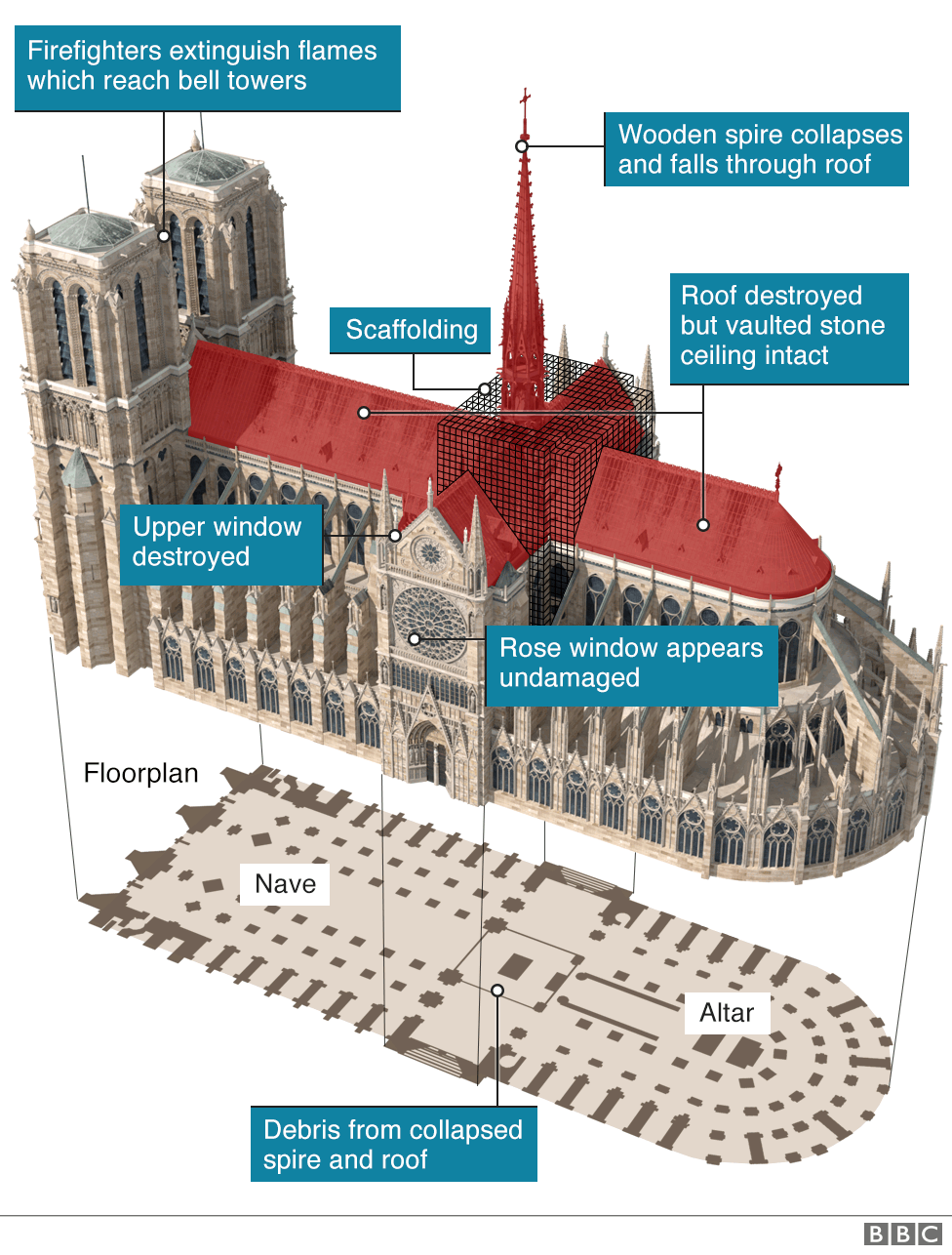
The roof is gone, the ceiling has 3 holes in it, the spire is gone.
The stone infrastructure is pretty much intact, the most valuable stained glass windows are intact, the organ is intact, the altar is intact, the bells and bell towers are intact.
Could have been so much worse.
It's amazing how little was actually destroyed -
The roof is gone, the ceiling has 3 holes in it, the spire is gone.
The stone infrastructure is pretty much intact, the most valuable stained glass windows are intact, the organ is intact, the altar is intact, the bells and bell towers are intact.
Could have been so much worse.

SeRpEnT
Executive Member
Just saw now they are going to have a competition for the best new design of replacement spire? Uhm... Why a new design?
Arthur
Honorary Master
Perhaps spending $1b on "all the other 'real' shite" (whatever that means) is even more of a waste. Who's to say, eh?Seems a waste considering all the other 'real' shite going on in the world where money needs to be channeled.
daveza
Honorary Master
So...a billion dollars raised to repair this building.
Seems a waste considering all the other 'real' shite going on in the world where money needs to be channeled.
Oh well - is what it is
Whoever donated to the restoration may well already be donating towards the other shite going on.

Prawnapple
Expert Member
- Joined
- May 18, 2015
- Messages
- 3,746
- Reaction score
- 2,666

TrueSeeker
Honorary Master
- Joined
- May 20, 2010
- Messages
- 13,301
- Reaction score
- 18,349
Nothing lasts forever.
daveza
Honorary Master
Nothing lasts forever.
White guilt ?

¯\_(ツ)_/¯
Honorary Master
- Joined
- Apr 20, 2005
- Messages
- 24,929
- Reaction score
- 27,926
But some lasts less than it should.Nothing lasts forever.
Gordon_R
Honorary Master
Just saw now they are going to have a competition for the best new design of replacement spire? Uhm... Why a new design?
The current spire was designed in the 19th century. It was nowhere near as old as the cathedral itself: https://www.bbc.com/news/world-europe-47959313
The spire destroyed in the blaze was added to the cathedral during a 19th Century restoration project led by French architect Eugene Viollet-le-Duc.
But Mr Philippe questioned "whether we should even recreate the spire as it was conceived by Viollet-le-Duc... or if, as is often the case in the evolution of heritage, we should endow Notre-Dame with a new spire".
Meanwhile, a copper statue of a cockerel - a symbol of France - that topped the spire has been recovered from the rubble "battered but apparently restorable", the culture ministry said. The cockerel contains holy relics, but it is not yet clear if these are still intact.
daveza
Honorary Master
Anyone know when the roof was built ?
Is it the original roof ?
Is it the original roof ?
Gordon_R
Honorary Master
Anyone know when the roof was built ?
Is it the original roof ?
According to Wikipedia, the roof was rebuilt after a lightning strike in 1161 AD, so there never was as original roof...
Wow, there's a Wikipedia page about the fire!? Comes up higher in the search list than the cathedral itself: https://en.wikipedia.org/wiki/Notre-Dame_de_Paris_fire
All your questions answered in great detail...
Renovation works often cause fires, and it is suspected that the Notre-Dame fire may have been caused by such work, which required blowtorch use. Repairs to the lead roof required welding lead sheets which rested on dry, well-seasoned timber, much of it porous or powdery with age. This is a particularly risky process for historic buildings.
Sounds like the firefighters did their best:
The Paris Fire Brigade had drilled regularly in preparation for any fire at the cathedral, including two training exercises held on the site last year. They also cooperated in the routine thrice-daily fire watch and the alarm system. They therefore knew the building and the difficulties of fighting a fire in it well.
The fire was primarily fought from the inside, in line with common French fire-fighting practice. Attacking the fire from the outside risked damaging the interior by deflecting flames and hot gases (at temperatures up to 800 °C) inwards. Twenty firefighters climbed inside the two towers. Deluge guns from ground-based vehicles were carefully used to douse the fire while avoiding further damage to the building. Following the plans the fire department made for such an emergency, boats were rapidly deployed on the Seine river to pump the water.
The possibility of aerial firefighting was discounted, as the weight of the water and the intensity of the drop at low altitude could have weakened the cathedral's structure. In addition, the limestone used in the construction of the cathedral could have cracked in the heat, especially if abruptly chilled by being doused with water.
Last edited:
daveza
Honorary Master
According to Wikipedia, the roof was rebuilt after a lightning strike in 1161 AD, so there never was as original roof...
Wow, there's a Wikipedia page about the fire!? Comes up higher in the search list than the cathedral itself: https://en.wikipedia.org/wiki/Notre-Dame_de_Paris_fire
All your questions answered in great detail...
So this wooden roof was over 800 years old ?
daveza
Honorary Master
Wow, there's a Wikipedia page about the fire!? Comes up higher in the search list than the cathedral itself: https://en.wikipedia.org/wiki/Notre-Dame_de_Paris_fire
The reliquary was believed to have been lost when the spire fell
I guarantee 99% who read the wiki page will look up the word on Google.....

Polymathic
Honorary Master
- Joined
- Mar 22, 2010
- Messages
- 33,669
- Reaction score
- 14,746
They should consider upgrading the roof and not use wood.Edit: See the before and after images in this link: https://www.bbc.com/news/world-europe-47947425
Pretty sure all of the large rose windows are intact, but they may have suffered micro-cracking of the glass from the intense heat: