-
- News
-
Categories
- 5G
- ADSL
- AI
- Banking
- Black Friday
- Broadband
- Broadcasting
- Business
- Business Telecoms
- Cellular
- Cloud and Hosting
- Columns
- Cryptocurrency
- Energy
- Enterprise
- Fibre
- Gadgets
- Gaming
- Government
- Hardware
- Industry News
- Internet
- Internet of Things
- Investing
- IT Services
- Motoring
- Reviews
- Science
- Security
- Smartphones
- Software
- Technology
- Telecoms
- Trending
- Wireless
- Press Office
- Forum
- Industry News
- What's Next
- Company hub
- Speed Test
- About us
- Advertise with us
- Contact
- Careers


-
Join the MyBroadband community
South Africa’s biggest forum. Discuss, discover, and connect with thousands of members.
-
Question of the Day: Have you had a bad taxi / ride hailing experience in South Africa?

You are using an out of date browser. It may not display this or other websites correctly.
You should upgrade or use an alternative browser.
You should upgrade or use an alternative browser.
Is online piracy theft?
- Thread starter rpm
- Start date
km2
Expert Member
[)roi(], capitalism and socialism are both economic systems built around allocating limited resources. All the other points listed about it by Wikipedia are the ways and means we go about doing that. And because you're forcing everything into a two-system world, left v right, capitalism v socialism, you're missing that piracy has nothing to do with either of those economic systems.
So as an example, in the world we currently have limited food available and difficulty distributing it:
The danger we have with piracy is that if everyone just keeps copying all the old content that already exists, and no one pays for new stuff, what incentive is there for new stuff to be made. Using the food analogy, why would anyone go and create a fantastic new delicious dish if he never gets any compensation for the time that he spent originally creating it. We want to solve world hunger, but we still want people to create new stuff, and that's what copyright was originally built to do.... give them a very limited temporary monopoly so they could sell their new stuff for a bit, but it would quickly return to be freely distributed afterwards.
Not because they "own" the idea or content, but we temporarily put restrictions on other people duplicating them to allow them to make money and encourage the creation of new ideas. This is my problem with calling it theft, calling it theft pre-assumes total ownership of ideas, whereas piracy is not following the incentive system.
If you want to claim that there is absolutely ownership on ideas and content itself, then there's all kinds of questions as to why copyright should ever expire, the whole remixing question, Disney using old stories without paying the great-great-great-grandchildren of the original authors, if someone tells you a secret and you then tell someone else... is that theft because you don't have permission from the original "content holder". Ugh.
So as an example, in the world we currently have limited food available and difficulty distributing it:
- Capitalism says that those who want it the most and are prepared to pay the most will get access to it.
- Communism says that some bureaucrat will decide who gets what food and when.
- Socialism takes some of the food from rich people and gives it to poor people.
- Piracy doesn't have a limited resource that it's working with, so everyone can get as much food as they want. You can all eat like kings.
The danger we have with piracy is that if everyone just keeps copying all the old content that already exists, and no one pays for new stuff, what incentive is there for new stuff to be made. Using the food analogy, why would anyone go and create a fantastic new delicious dish if he never gets any compensation for the time that he spent originally creating it. We want to solve world hunger, but we still want people to create new stuff, and that's what copyright was originally built to do.... give them a very limited temporary monopoly so they could sell their new stuff for a bit, but it would quickly return to be freely distributed afterwards.
Not because they "own" the idea or content, but we temporarily put restrictions on other people duplicating them to allow them to make money and encourage the creation of new ideas. This is my problem with calling it theft, calling it theft pre-assumes total ownership of ideas, whereas piracy is not following the incentive system.
If you want to claim that there is absolutely ownership on ideas and content itself, then there's all kinds of questions as to why copyright should ever expire, the whole remixing question, Disney using old stories without paying the great-great-great-grandchildren of the original authors, if someone tells you a secret and you then tell someone else... is that theft because you don't have permission from the original "content holder". Ugh.
Last edited:
The ones and zeros may be tangible, but the goods they form are as intangible as ever. Once those ones and zeros are piled together in a heap, they lose all value - their value exists solely in their arrangement. Music is therefore still intangible, and still subject to the principles mentioned by km2, and myself (in another thread.) Any attempt to infer that intangible goods require and deserve the protections afforded to tangible goods is always going to be shot down by everyone from commune hippies to philosophy professors, and rightly so.
We don't need laws that confuse the two types of goods, we need laws that are designed from the start to embrace the reality of near-zero-cost copying and benefits it imparts on society, while at the same time encouraging new development and innovation. The current intellectual "property" suite of laws and treaties doesn't do that, and until it's redesigned, no-one is going to respect it.
I have not studied economics and I am pretty confused on my feelings to piracy and copying as well. Put simply : I work 8 hours a day, 5 days a week for about 51 weeks a year. My product cannot be duplicated, and I get paid RX/hour. A musician can spend a day in the studio ( as per some famous singles ) and produce a product that can be duplicated through the music industry (with the associated marketing and distribution costs).
I can allow the industry to take their some profit (shops, warehousing, logistics, cd press, recording studio and risk takers/investors) but I have a problem with the musician that worked for a day (and shareholders who don't), and can take millions on that single. I know that the reality is that there is few of the latter, but they cause a disparity in my economic model. A hundred years ago that musician would have had to put in as many hours as I. And a lot more would have been employed and earning a smaller living, rather than a few earning a lot.
The problem I have with free is that in that time I am not producing. Download a 1000 hours of entertainment. In the time that I am watching for free I am only consuming. I do feel better when I know I put in to get out. (Root problem though, is that they ask too much.)
Told ya I was pretty confused.
I wonder how many of the piracy advocates work in IT.
I'd like to see their viewpoint when the boss walks in one day and says:
"Listen up guys, there are 2 million people using our software, yet only 10 have paid for it. So because of that, you are all fired with no benefits and by the way you won't be getting paid this month. cheers."
I'd like to see their viewpoint when the boss walks in one day and says:
"Listen up guys, there are 2 million people using our software, yet only 10 have paid for it. So because of that, you are all fired with no benefits and by the way you won't be getting paid this month. cheers."
Elimentals
Honorary Master
I wonder how many of the piracy advocates work in IT.
I'd like to see their viewpoint when the boss walks in one day and says:
"Listen up guys, there are 2 million people using our software, yet only 10 have paid for it. So because of that, you are all fired with no benefits and by the way you won't be getting paid this month. cheers."
Jokes is on you, my company makes money from a service not the software, all our software is Open Source and can be downloaded freely

Jokes is on you, my company makes money from a service not the software, all our software is Open Source and can be downloaded freely
And if people stop paying for their service?

xera
Expert Member
Its like buying a book, and saying you can only read it on one couch in your house, and may not take it in your car, on holiday or wherever else.
My sentiments exactly

Elimentals
Honorary Master
And if people stop paying for their service?
Thats like asking if people stop paying for a doctor or not paying for university... Simple stop paying for our service then you don't get any. The key is to position your services in such a manner that people would want to pay for it.
Face it, argument failed. Esp when it meets the Open Source world.
http://www.scenicreflections.com/files/you_wouldn_t_download_a_car_Wallpaper__yvt2.jpg
contains a word you shouldn't use....
kwakwakwa.....! you cracked me up

AfricanTech
Honorary Master
And if people stop paying for their service?
Then they stop receiving service and learn to fix it themselves when it breaks
Elimentals
Honorary Master
http://www.scenicreflections.com/files/you_wouldn_t_download_a_car_Wallpaper__yvt2.jpg
contains a word you shouldn't use....
You know what is gonna be funny. If they don't sort out the "piracy issue" before 3D printers become a simple household appliance like a microwave.
Cause I can see loads of things people would rather Download & print than go buy at a shop.

bin3
Senior Member
- Joined
- Jun 22, 2005
- Messages
- 976
- Reaction score
- 15
You know what is gonna be funny. If they don't sort out the "piracy issue" before 3D printers become a simple household appliance like a microwave.
Cause I can see loads of things people would rather Download & print than go buy at a shop.
Look for Physibles on the p bay: Still a way to go, but ...
robdutchmonkey
Well-Known Member
I know I'm late here and I skipped a few pages but this is a question directed at roi:
If you feel it's theft to make a copy of a movie instead of buying it, doesn't that make Multichoice the country's biggest right hand man allowing it?
Reason I ask this is because if you buy a pvr and recorded a movie, you're denying the maker the revenue by not buying it, so you're saying everyone using a pvr is a criminal and Multichoice should be taken to task?
If you feel it's theft to make a copy of a movie instead of buying it, doesn't that make Multichoice the country's biggest right hand man allowing it?
Reason I ask this is because if you buy a pvr and recorded a movie, you're denying the maker the revenue by not buying it, so you're saying everyone using a pvr is a criminal and Multichoice should be taken to task?

cozinsky
Expert Member
Piracy is not theft! The legal opinions are quite correct. Theft is a common law crime from the Roman times already when intellectual property did not even exist. Intellectual property is protected by statute. The cheap marketing ploy of copyright holders to scare us with theft threats does not cut it anymore. Having said that, it is still commendable to purchase the originals considering the time and effort the developers put into their products. This afternoon, I will purchase the original Diable 3 for instance even though it is a hefty R500.
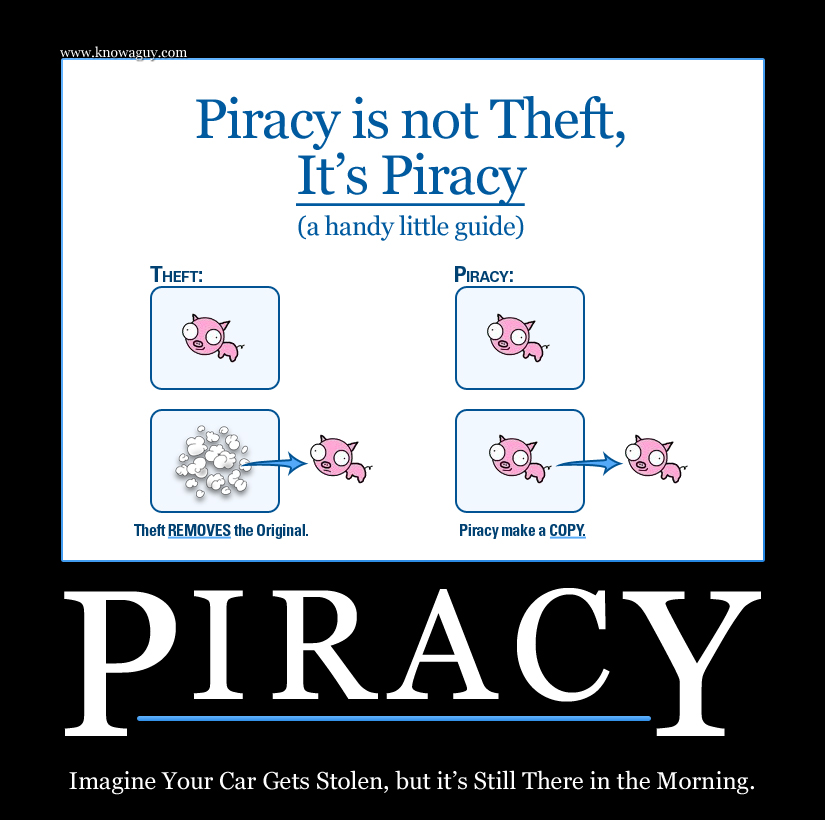
Piracy is not Theft! It's Violent Robbery
The only infinite resource known to Economic science is stupidity.
The products which can be digitised will be distributed by copying, there is nothing to prevent this.
Eventually (or sooner) the control of distribution will pass to companies that provide these products
gratis (not quite). So you will get your music, movies blah blah when you pay for electricity, or ADSL, or
petrol, laser toner, who knows.
The products will still cost money to make, which will be recouped somehow, but as economic products they will be worthless outside the supply chain.
The only infinite resource known to Economic science is stupidity.
The products which can be digitised will be distributed by copying, there is nothing to prevent this.
Eventually (or sooner) the control of distribution will pass to companies that provide these products
gratis (not quite). So you will get your music, movies blah blah when you pay for electricity, or ADSL, or
petrol, laser toner, who knows.
The products will still cost money to make, which will be recouped somehow, but as economic products they will be worthless outside the supply chain.
murraybiscuit
Executive Member
Thats like asking if people stop paying for a doctor or not paying for university... Simple stop paying for our service then you don't get any. The key is to position your services in such a manner that people would want to pay for it.
Face it, argument failed. Esp when it meets the Open Source world.
so following on from your metaphor, how do you propose artists make their money then?
by providing their work for free and selling a complementary service? how would that work?
murraybiscuit
Executive Member
I know I'm late here and I skipped a few pages but this is a question directed at roi:
If you feel it's theft to make a copy of a movie instead of buying it, doesn't that make Multichoice the country's biggest right hand man allowing it?
Reason I ask this is because if you buy a pvr and recorded a movie, you're denying the maker the revenue by not buying it, so you're saying everyone using a pvr is a criminal and Multichoice should be taken to task?
licensing models take this into account by offsetting the content cost with advertising, additional hardware and subs. that and the fact that half of your hard drive is filled with re-runs anyways.
murraybiscuit
Executive Member
Piracy is not Theft! It's Violent Robbery
The only infinite resource known to Economic science is stupidity.
The products which can be digitised will be distributed by copying, there is nothing to prevent this.
Eventually (or sooner) the control of distribution will pass to companies that provide these products
gratis (not quite). So you will get your music, movies blah blah when you pay for electricity, or ADSL, or
petrol, laser toner, who knows.
The products will still cost money to make, which will be recouped somehow, but as economic products they will be worthless outside the supply chain.
sounds too theoretical for me.
what if i don't like the choice of content that's available?
what if artists don't like the terms of the service provider and decide not to use them?
remind me how the artist will be "recouped somehow"?
Elimentals
Honorary Master
so following on from your metaphor, how do you propose artists make their money then?
by providing their work for free and selling a complementary service? how would that work?
If you go back in the thread history you will see that I mention live shows also they get money from radio spots, YouTube ads on so on. Its not like selling mp3s ate their only means of income.
murraybiscuit
Executive Member
I can allow the industry to take their some profit (shops, warehousing, logistics, cd press, recording studio and risk takers/investors) but I have a problem with the musician that worked for a day (and shareholders who don't), and can take millions on that single. I know that the reality is that there is few of the latter, but they cause a disparity in my economic model. A hundred years ago that musician would have had to put in as many hours as I. And a lot more would have been employed and earning a smaller living, rather than a few earning a lot.
there are two problematic assumptions here:
1. hours worked = value to the market.
2. making it to the top and staying there doesn't require hard work in the entertainment industry.