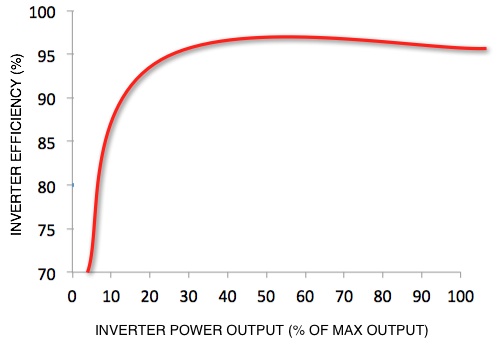
Why would load rate affect mppt efficiency?
First off - I do enjoy answering these sort of questions, so keep asking.
(I'll probably make this into another blog post at
https://goingsolar.co.za once I flesh it out a bit more)
Also - I'm not an electrical engineer, and don't claim to know too much of the nitty gritty detail on design choices (although I do have a background in embedded hardware design, so am more familiar than your average consumer). Going into the safety and design decisions is best left to others. While I can read a data sheet and read a board design, I wouldn't claim to know why the choices were made other than at a rudimentary level.
If you are interested, Energytalk and powerforum have had design discussions in thread in the past.
Back to your question -
The Hybrid Inverter design is optimized for certain voltage thresholds, and loads.
The circuitry is more efficient when used within recommended values - its designed that way.
The Sunsynk / Deye or other all in one hybrid inverters are really multiple things in one.
MPPT circuitry - to handle the solar
Inverter circuitry - to convert between 48v and 240v AC
Various safety bits and system UI.
The MPPT circuit will be lossy, as will the inverter circuitry. The idea of system design is to keep those losses minimal by optimizing the panel configuration (and usage configuration if feasible) to sit the inverter within its optimal usage range. The MPPT circuitry is pretty good, its the inverter side that will be less efficient depending on output (load rate).
Don't forget that the inverter also needs to cater for excess outside of its range too. Most inverters will be able to handle excess load (typically 10%-15%) for a short period of time before overheating.
That safety margin also adds some potential inefficiencies.
The Sunsynk is already pretty efficient at 96-97% throughout most of its range.
My Growatt 10kW 3 phase claims to be 98% efficient.
Thats pretty darn good. Inverters are only one part of the system though.
Batteries are another. Batteries will also have efficiency ratings - I can't seem to find much info on commonly used brands in SA, but you can generally work on an efficiency of about 90% for Lithium based batteries.
Effectively that means if you store from solar <-> batteries, you'll be losing a maximum of 15% of your generated energy. Sounds high, but thats actually not bad, especially compared to previous battery technologies (looking at you Dead Acid).
Panels -> MPPT +- 1% loss
MPPT <-> Batteries +- 10% loss (includes both in / out)
Batteries -> Inverter -> AC +-3% loss.
Other small losses in system +-0.5%
Rounded up total = +- 15% for your generated electricity from panels -> battery -> inverter -> A/C
Inverter will also take some extra juice in order to run, so there will be some additional small losses not covered by efficiency. eg my Victron 3kW uses 50w or so to run consistently. I haven't measured my Sunsynk yet, but seems to be in the 50-150w range, depending on use range. I need to measure and verify that though before making claims. Just haven't gotten around to it yet.
Looking back to the inverter ratings, you'll often note a few values. Max, Euro, MPPT. These relate to the different parts of the system (MPPT for MPPT efficiency), or for Euro and Max, the inverter efficiency.
The various efficiency ratings for the Deye/Sunsynk/whatever other rebrands that Deye claims to run at are:
- Max. Efficiency - 97.5%
- Euro Efficiency - 97.3%
- MPPT Efficiency - >99%
I know you're going to ask next what the differences are between the efficiency ratings, so I've copy and pasted below. Essentially the TL;DR is that Euro (European) or CEC (US'ian) are blended ratings, Max is the best efficiency capable from the inverter. For obvious reasons, our typical comparison will be Euro efficiency, as we don't run 120v.
The longer version (Snarfing from the internet, as I'm lazy) -
The Efficiency of Solar Inverters The efficiency of an inverter indicates how much DC power is converted to AC power. Solar inverters are very efficient, usually 93-96 percent depending on the make and model. Their efficiency will never be 100 per cent because some of the power can be lost as...
www.srnesolar.com
Inverters have what is called an ‘efficiency curve’, usually displayed in a chart that shows how efficiency fluctuates with the input power or voltage fed into it. Each brand and model of inverter has its own efficiency curve.
You may encounter the following terms referring to efficiency when looking for an inverter: peak efficiency, Euro efficiency and CEC efficiency. The difference between these is explained below.
Peak Efficiency
Peak efficiency indicates the performance of the inverter at the optimal power output. It shows the maximum point for a particular inverter and can be used as a criterion of its quality.
Simply put, peak efficiency is calculated as DC input to AC output when the inverter is operating at (usually) its rated capacity. For some of the best inverters, the peak efficiency can be up to 99%. That sounds pretty impressive, but remember that although this is a noteworthy number, it is not the final word on inverter efficiency. Your inverter may only operate in its peak efficiency range for a very small part of the day or not at all. This is why the CEC and Euro weighted efficiencies have been developed. They recognize that inverters don’t always operate in optimal conditions, and instead these measurements offer an indication of how an inverter might perform throughout the day.
European and CEC Efficiency
European efficiency is the weighted number taking into consideration how often the inverter will operate at different power outputs. It is sometimes more useful than peak efficiency as it shows how the inverter performs at different output levels during a sunny day.
California Energy Commission (CEC) efficiency is also a weighed efficiency, similar to the European efficiency, but it uses different assumptions on weighing factors.
Euro efficiency and CEC efficiency are both ‘weighted’ efficiencies. In calculating them, the efficiency of an inverter at different spots within the operating range are taken into consideration and balanced against each other depending on importance. These measures are generally more useful than peak efficiency because they measure inverter performance across the range of the inverter’s capacity. This gives you a fuller picture about the inverter’s operating profile over the course of the day.
In calculating CEC and Euro efficiency, instead of looking only at how efficiently the inverter functions at its power input ‘sweet spot’, calculating weighted efficiency requires first selecting a few DC input levels relative to the inverter’s rated capacity.