SauRoN's SomeWatt Solar Install

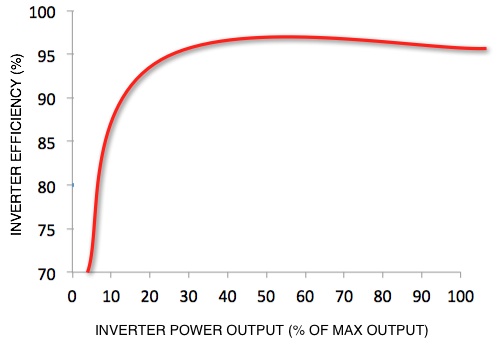
Efficiency curve chart for the inverter (snarfed from the manual)
It's a small loss overall, but ideally you want to optimise everything.

I'm probably complaining a little too much here.
It's not the end of the world, and you have decent equipment that you will be happy with.

If you do have the chance or opportunity to add some now, push for that, if you can't right now, thats also ok.

Ultimately, you will add more generation or storage to your system, as you'll know your usage better after some actual use.

Enjoy being grid independent!


View attachment 1314308
What is load rate?
 
To repeat -

You could also go 9S2P if you wanted, but I'd recommend balance loads between the MPPT's vs all on one.

You have 14 panels though, so will probably need to go for the not so optimal 7S per MPPT, which is lower than the inverter likes for efficiency.

----

Your inverter will be happier with 9 in series of your current panel choice. When I say happier - I mean more effiicent. At 270v for 7S, the inverter efficiency will be lower.

Its at best efficiency sitting at 370w or so (which is where 9S sits).

Ideally you should have bought another 4 panels, which is something I did talk about previously - buying more panels and installing on the roof one time makes more sense to do, vs adding later, especially when its a small additional amount.

Right now you have 14 panels, so wire in 7S -> each MPPT. Later I'd reconnect those as 9S, which will probably cost you about the same amount to do as putting in 4 more panels now (i.e. doubling that cost at a later stage)

Getting someone in to reconnect, labour, mounting etc will cost more than just adding it now imho.


Who is doing your install?

This sort of thing is the first thing I'd have picked up and told the customer about - i.e. being optimal about panel usage. Yes, sometimes there are other things which influence - eg roof size, budgetary issues etc, but optimizing panel voltage for the inverter is a no brainer and should be something your installer or planner talked about and did.

As I’ve said before roof is the exact constraint.

There cannot be any more panels North facing.

We are at the absolute limit with 14 panels as it stands.

And likely to be a bigger efficiency problem doing 9 and 9 on different parts of the roof as the shade from the chimney in the late afternoon would mess both strings up then, exactly when you want to eek out that little bit more.

All the installer details in the thread title and first post.
 
Last edited:
No, it's an 8K inverter, so 10400W in total for both MPPTs :sneaky:
Maximum of 500V per MPPT, and 22A (which means that for max you will need to wire the panels (roughly) 6S2P for each MPPT for a total of 24 (don't quote me on the 24, it's a rough calc, I haven't seen the panel's specsheet).
Best to work on 5200W per MPPT.

Okay so I wasn’t losing the plot.

I’d need to re-balance it down the line.
 
Check Keith Gough's vid I posted. VOC is the main factor. Don't exceed 480v... Even dial down a little to account for the sunniest day you'll have. As for efficiency, it's negligible. Don't worry about such small details IMO.

Isn’t that the same video where he says it has handled near 600V without an issue though?

Obviously that wouldn’t be a good idea warranty wise.
 
As I’ve said before roof is the exact constraint.

There cannot be any more panels North facing.

We are at the absolute limit with 14 panels as it stands.

And likely to be a bigger efficiency problem doing 9 and 9 on different parts of the roof as the shade from the chimney in the late afternoon would mess both strings up then, exactly when you want to eek out that little bit more.

All the installer details in the thread title and first post.
The other options is higher wattage panels, but no point harping on about things. I think a bit more discussion pre-purchase may have been useful, so we could chip in with our suggestions.

Enjoy your system - being able to self provide is great, especially when you don't even notice when there is loadshedding!
 
How much you are using.

A load rate of 100% would mean you're pulling 8kW out of an 8kW inverter.

Most will sit at loads of 10% or less for the majority of the time, then peak when larger ticket items turn on and draw power - eg Geyser etc
Why would load rate affect mppt efficiency?
 
Why would load rate affect mppt efficiency?
First off - I do enjoy answering these sort of questions, so keep asking.
(I'll probably make this into another blog post at https://goingsolar.co.za once I flesh it out a bit more)

Also - I'm not an electrical engineer, and don't claim to know too much of the nitty gritty detail on design choices (although I do have a background in embedded hardware design, so am more familiar than your average consumer). Going into the safety and design decisions is best left to others. While I can read a data sheet and read a board design, I wouldn't claim to know why the choices were made other than at a rudimentary level.
If you are interested, Energytalk and powerforum have had design discussions in thread in the past.

Back to your question -

The Hybrid Inverter design is optimized for certain voltage thresholds, and loads.
The circuitry is more efficient when used within recommended values - its designed that way.
The Sunsynk / Deye or other all in one hybrid inverters are really multiple things in one.

MPPT circuitry - to handle the solar
Inverter circuitry - to convert between 48v and 240v AC
Various safety bits and system UI.

The MPPT circuit will be lossy, as will the inverter circuitry. The idea of system design is to keep those losses minimal by optimizing the panel configuration (and usage configuration if feasible) to sit the inverter within its optimal usage range. The MPPT circuitry is pretty good, its the inverter side that will be less efficient depending on output (load rate).

Don't forget that the inverter also needs to cater for excess outside of its range too. Most inverters will be able to handle excess load (typically 10%-15%) for a short period of time before overheating.
That safety margin also adds some potential inefficiencies.

The Sunsynk is already pretty efficient at 96-97% throughout most of its range.
My Growatt 10kW 3 phase claims to be 98% efficient.

Thats pretty darn good. Inverters are only one part of the system though.
Batteries are another. Batteries will also have efficiency ratings - I can't seem to find much info on commonly used brands in SA, but you can generally work on an efficiency of about 90% for Lithium based batteries.

Effectively that means if you store from solar <-> batteries, you'll be losing a maximum of 15% of your generated energy. Sounds high, but thats actually not bad, especially compared to previous battery technologies (looking at you Dead Acid).

Panels -> MPPT +- 1% loss
MPPT <-> Batteries +- 10% loss (includes both in / out)
Batteries -> Inverter -> AC +-3% loss.
Other small losses in system +-0.5%

Rounded up total = +- 15% for your generated electricity from panels -> battery -> inverter -> A/C

Inverter will also take some extra juice in order to run, so there will be some additional small losses not covered by efficiency. eg my Victron 3kW uses 50w or so to run consistently. I haven't measured my Sunsynk yet, but seems to be in the 50-150w range, depending on use range. I need to measure and verify that though before making claims. Just haven't gotten around to it yet.

Looking back to the inverter ratings, you'll often note a few values. Max, Euro, MPPT. These relate to the different parts of the system (MPPT for MPPT efficiency), or for Euro and Max, the inverter efficiency.
The various efficiency ratings for the Deye/Sunsynk/whatever other rebrands that Deye claims to run at are:
  • Max. Efficiency - 97.5%
  • Euro Efficiency - 97.3%
  • MPPT Efficiency - >99%
I know you're going to ask next what the differences are between the efficiency ratings, so I've copy and pasted below. Essentially the TL;DR is that Euro (European) or CEC (US'ian) are blended ratings, Max is the best efficiency capable from the inverter. For obvious reasons, our typical comparison will be Euro efficiency, as we don't run 120v.

The longer version (Snarfing from the internet, as I'm lazy) -


Inverters have what is called an ‘efficiency curve’, usually displayed in a chart that shows how efficiency fluctuates with the input power or voltage fed into it. Each brand and model of inverter has its own efficiency curve.

You may encounter the following terms referring to efficiency when looking for an inverter: peak efficiency, Euro efficiency and CEC efficiency. The difference between these is explained below.

Peak Efficiency


Peak efficiency indicates the performance of the inverter at the optimal power output. It shows the maximum point for a particular inverter and can be used as a criterion of its quality.

Simply put, peak efficiency is calculated as DC input to AC output when the inverter is operating at (usually) its rated capacity. For some of the best inverters, the peak efficiency can be up to 99%. That sounds pretty impressive, but remember that although this is a noteworthy number, it is not the final word on inverter efficiency. Your inverter may only operate in its peak efficiency range for a very small part of the day or not at all. This is why the CEC and Euro weighted efficiencies have been developed. They recognize that inverters don’t always operate in optimal conditions, and instead these measurements offer an indication of how an inverter might perform throughout the day.


European and CEC Efficiency


European efficiency is the weighted number taking into consideration how often the inverter will operate at different power outputs. It is sometimes more useful than peak efficiency as it shows how the inverter performs at different output levels during a sunny day.

California Energy Commission (CEC) efficiency is also a weighed efficiency, similar to the European efficiency, but it uses different assumptions on weighing factors.

Euro efficiency and CEC efficiency are both ‘weighted’ efficiencies. In calculating them, the efficiency of an inverter at different spots within the operating range are taken into consideration and balanced against each other depending on importance. These measures are generally more useful than peak efficiency because they measure inverter performance across the range of the inverter’s capacity. This gives you a fuller picture about the inverter’s operating profile over the course of the day.

In calculating CEC and Euro efficiency, instead of looking only at how efficiently the inverter functions at its power input ‘sweet spot’, calculating weighted efficiency requires first selecting a few DC input levels relative to the inverter’s rated capacity.
 
Last edited:
No LOL. Where did he say that? If he said anything like that it was to demonstrate that the suggested operating range is safe. They build in alot of safety to these units.

Keith is Mr Sunsynk. Probably the most knowledgeable guy I've come across all round... Lots of useful videos on their channel.

Somewhere in one of his videos he was talking about extreme cases and what the inverter can actually handle.

Like you say there are so many it's hard to say which one where as he is all over the place.

Obviously for warranty reasons they would trim it back into normal spec ranges to cover themselves.

But yeah him being so hands-on as the owner of the company is ultimately what swayed me to the Sunsynk.
 
Somewhere in one of his videos he was talking about extreme cases and what the inverter can actually handle.

Like you say there are so many it's hard to say which one where as he is all over the place.

Obviously for warranty reasons they would trim it back into normal spec ranges to cover themselves.

But yeah him being so hands-on as the owner of the company is ultimately what swayed me to the Sunsynk.
Yeah, he's done well.

China is great at good hardware. Software - less so.
Picking a quality product (Ningbo's Deye inverters) and rebranding, and redoing the software to make them more western friendly is smart.

I have looked at doing that in the past myself - mostly for ip-camera's, but alas never came to fruition.
Did 95% of the work, but didn't have the push (or funding) to get to completion.

I really should have gotten into kickstarter for one of my other product idea's though. That would have done well I think (OpenJamma - an open source Jamma pcb running on Allwinners A20 series).
Even paid for the pcb design, BoM etc at the time too.

I'm not based in China these days, so less opportunities for that.

Digressing though :)
 
I promised I would create a separate thread as things start happening and today the solar panels and batteries were delivered so I figured it's as good a time as any.

View attachment 1311126
This is the quotation I accepted from Dean at Somewatt Solar who is both the owner of the business and also the one who does the final commissioning which is by and large what swayed me towards them as it's not just a salesperson handing it over to someone else as was my experience with other quotes.

Dean is also the only installer who actually came out and got on the roof and measured and didn't just use Google Maps to do the initial quotation and a big guess with the intention of a final inspection only after the quote is accepted.

We settled on going with the 3 x 4.8 kWh Dyness batteries with the intention of seeing how it goes and then potentially upgrading if required.

The invoice will be updated slightly down the line because there was some stock issues and the JA Solar panels were exchanged for Canadian Solar 450W instead.

What do you give to your insurance to ensure no issues in the event of a related claim?
 
What do you give to your insurance to ensure no issues in the event of a related claim?
I sent them the invoice and they added it to the building cover.

It was so negligible I didn't even stress about needing to do it in the future once installed and it kicked off week before last already when I accepted the quote.

I don't see how the insurer could say too much if it's been SSEG registered.
 
So many what? Where did I say that?
Videos on Sunsynk.
No, it's trimmed back to make sure you don't exceed because there are many variables, it's not black and white. He demonstrates that with the ohms law calc. You don't know the exact resistance.

I do enjoy that about Keith. He does vids. What blows my mind is how many installers, despite that info being out there, just flout the recommendations and don't do proper installs.
Yeah I've been meaning to actually sit through the training videos before the install happened, but didn't get around to it.
 
I sent them the invoice and they added it to the building cover.

It was so negligible I didn't even stress about needing to do it in the future once installed and it kicked off week before last already when I accepted the quote.

I don't see how the insurer could say too much if it's been SSEG registered.
Ok. So it's the SSEG cert.

Just had someone mention to me the other day that the CoC is not enough for insurance purposes and was wondering what else is needed.
 
95% there but the rain has thwarted the PV getting done.

e52d70bc9d694da3714741f1b7647471.jpg


Fighting with the HA integration but will ask for some help later there.
 
95% there but the rain has thwarted the PV getting done.

e52d70bc9d694da3714741f1b7647471.jpg


Fighting with the HA integration but will ask for some help later there.
It looks like batteries are connected to Inverter right? So LS shouldnt be an issue for you tonight?
 
Top
Sign up to the MyBroadband newsletter
X