Article Mistake corrections


In a raft draft of regulations published on Thursday (2 April), government also provided clarity on how many people are allowed to travel in a private vehicle.
 

A small South African tech company called LightWare produces the world’s lightest and most compact scanning LiDAR unit – which is now used by global technology companies.

LiDAR is a detection system which works on the same principle as radar, but uses light from a laser instead of sound to detect objects.

SONAR uses sound, in water while RADAR uses radio waves, typically in air/space; 'sound' there is utterly incorrect.
 

At this stage, the average number of daily cases for the week is at 95.3. This is above the 90-case mark, which Karim said should result in a lockdown extension.

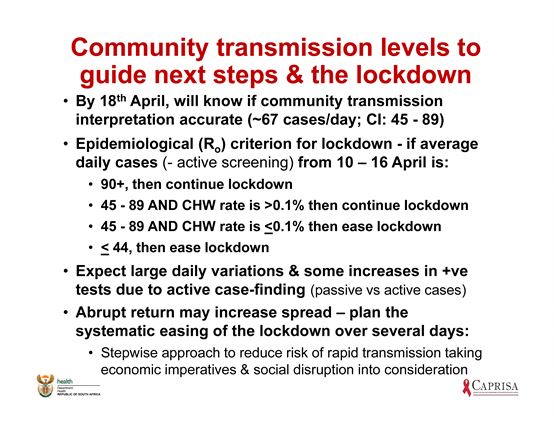
This is not the correct interpretation of the guidelines for lockdown extension. The actual slide presented by Professor Karim had the following extra term:
if average daily cases (- active screening)

The term "- active screening" excludes cases that were found by contact tracing, but were not actually sick, and have already been placed in preventive isolation. There will be two separate numbers for new daily cases, with the lower term representing those sick people who present at hospitals and are found to test positive.

Therefore the graph and conclusion of the article is incorrect.

612de9f34bc1463a99428fe31aa5ef19.jpg


Source: https://cdn.24.co.za/files/Cms/General/d/9102/b631937c3b1f4b54a24620a943c42d20.pdf
 
Not surprising that they leave out important information to draw their own biased conclusions. :sick:

My comment is not guaranteed accurate, but it needs to be checked and verified before publication. If wrong, it needs to be retracted, and a corrected article published. I don't think MyBB are the only ones to miss it, since it is in small (tiny) print...

P.S. The meaning of the slide is very clear:
Community transmission cannot include outbreaks in hospitals and prisons, since they are not subject to lockdown.

Edit: News24 have done the same thing, compare the skyrocketing number of positive tests, with the target of 90 new cases per day:
Using a statistical tool called the "95% confidence interval" to calculate the number of average cases, Karim said government could determine the success of the lockdown.

If the daily average is 90 cases or more, it means cases are increasing.

No mention of excluding active screening cases.
 
Last edited:
Therefore the graph and conclusion of the article is incorrect.
Can you give us the numbers which you think are correct?

We correlated all the numbers shared by the prof, and it all checked out. But maybe you have additional information.
 
Can you give us the numbers which you think are correct?

We correlated all the numbers shared by the prof, and it all checked out. But maybe you have additional information.

There are no independent numbers yet. Those will only be published at the end of the week.

The first step is to subtract known outbreak hotspots, such as hospitals and prisons, which are clearly not part of the "Community" spread.
 
Thanks for the additional info. We clarified the numbers as follows:

The chart below shows the average number of new daily cases between 10-15 April.

The red line, at 90 cases, is when the lockdown should continue. The green line, at 44 cases, is when lockdown should be eased.

At this stage, the average number of daily cases for the week is at 95.3. This is above the 90-case mark, which Karim said should result in a lockdown extension.

It should be noted that Karim’s criteria look at passive screening only. Should a significant number of cases this week be the result of active screening, this number may be reduced.

The breakdown of passive and active testing cases is, however, not provided by the Department of Health.

For this comparison MyBroadband therefore used the total number of new daily cases – the same number which Karim used for his calculations over the past five weeks.
 
There are no independent numbers yet. Those will only be published at the end of the week.

The first step is to subtract known outbreak hotspots, such as hospitals and prisons, which are clearly not part of the "Community" spread.
From what Karim said it looks like his main focus is to ensure the testing methodology is the same. Therefore all passive testing.

It is somewhat challenging as the church in the Free State was included in passive testing, but this is more active testing.

For a final figure we may have to wait for 18 April. The daily numbers give a good guideline, but the breakdown is indeed a mystery.
 
From what Karim said it looks like his main focus is to ensure the testing methodology is the same. Therefore all passive testing.

It is somewhat challenging as the church in the Free State was included in passive testing, but this is more active testing.

For a final figure we may have to wait for 18 April. The daily numbers give a good guideline, but the breakdown is indeed a mystery.

My understanding is that outbreaks cannot be included in the target of 90 per day. If this were so, the lockdown would never end. The fear of an unlimited lockdown is what many people are responding do.

The reality is sombre, but with glimmers of hope...
 
Thanks for the additional info. We clarified the numbers as follows:

The chart below shows the average number of new daily cases between 10-15 April.

The red line, at 90 cases, is when the lockdown should continue. The green line, at 44 cases, is when lockdown should be eased.

At this stage, the average number of daily cases for the week is at 95.3. This is above the 90-case mark, which Karim said should result in a lockdown extension.

It should be noted that Karim’s criteria look at passive screening only. Should a significant number of cases this week be the result of active screening, this number may be reduced.

The breakdown of passive and active testing cases is, however, not provided by the Department of Health.

For this comparison MyBroadband therefore used the total number of new daily cases – the same number which Karim used for his calculations over the past five weeks.


Please include this clarification in the article, and modify the conclusions accordingly. Until more information is available, the article is somewhat alarmist.
 
Top
Sign up to the MyBroadband newsletter
X