Japan to dump 11 000 tonnes of radioactive water in ocean.

Master Cain

Expert Member
Joined
Jun 11, 2009
Messages
1,316
Reaction score
0
On BBC World news.

Japan intends dumping 11 000 tonnes of radioactive water in the Pacific ocean.

Apparently they do not know what else to do with all the radioactive waste water.
 
The water they plan to dump is only about 100x more radioactive than what is considered safe. This won't have a negative impact on humans, or so they say on BBC.
 
Workers at Japan's quake-hit nuclear plant have begun dumping water with low levels of contamination into the sea to free up room to store more highly radioactive water leaking at the site.

About 11,500 tonnes of water will be released into the sea at the crippled Fukushima Daiichi nuclear plant.

Water with a higher level of radioactivity leaking from the No 2 reactor can then be stored.

Efforts to tackle that leak are continuing.

The source of the leak was identified at the weekend as a 20cm (8in) crack in a concrete pit at reactor 2.

Workers are now using dye to try to trace the route of the water, after earlier efforts to plug the hole using a highly absorbent polymer failed.
'No choice'

Operator Tepco has been been struggling for more than three weeks to regain control at the plant after the huge earthquake and tsunami knocked out the cooling systems.
Continue reading the main story

Workers face a dilemma - they must keep feeding water into the reactors to stop them overheating, but must then deal with the accumulation of waste water.

Top government spokesman Yukio Edano said that there was no choice but to release some water.

"We are already aware that the water at the No 2 unit is highly radiated," he said.

"So as to prioritise to stop the leakage of this water into the sea... we will release the water stored in the exterior building of the unit, which also unfortunately contains radioactivity but far lower than the highly contaminated water."

The water to be released into the sea contains some 100 times the legal limit of radiation - a relatively low level, says the BBC's Roland Buerk in Tokyo.

"As it is not harmful to people's health and as it is necessary to avert an even bigger danger, we decided it was inevitable," said Hidehiko Nishiyama of Japan's Nuclear and Industrial Safety Agency (Nisa).

Stopping the leak from reactor 2 remains the priority, Mr Edano said earlier.

Tepco says it will inject the polymer again to try to block the flow of radioactive water as soon as it has identified the path of the leak.

As a temporary measure, Nisa is considering building embankments of silt near reactor No 2 to stem the leak into the ocean.

http://www.bbc.co.uk/news/world-asia-pacific-12954664


Not a surprise. All those tonnes of water they were pouring onto the reactors was going to have to go somewhere
 
Better to avoid eating fish for the next 35 000 years.

Avoid at all cost if your dinner glows in the dark.
 
we're not worried about the humans, we are worried about the marine life!
 
What else can they do with the radioactive water? Good move, there is no time to try and "recycle" the radiation...The US, Europe, Russia, China etc would have ALL done the same.
 
Being rather hysterical Cain. It's low level radioactive waste. The fish you eat now is loaded with nasty chemicals.

For example mercury

In 1950s, inhabitants of the seaside town of Minamata, on Kyushu island in Japan, noticed strange behavior in animals. Cats would exhibit nervous tremors, dance and scream. Within a few years this was observed in other animals; birds would drop out of the sky. Symptoms were also observed in fish, an important component of diet, especially for the poor. When human symptoms started to be noticed around 1956 an investigation began. Fishing was officially banned in 1957. It was found that the Chisso Corporation, a petrochemical company and maker of plastics such as vinyl chloride, had been discharging heavy metal waste into the sea. They used mercury compounds as catalysts in their syntheses. It is believed that about 5,000 people were killed and perhaps 50,000 have been to some extent poisoned by mercury. Mercury poisoning in Minamata, Japan, is now known as Minamata disease.

A book by Jane Hightower, Diagnosis Mercury: Money, Politics and Poison, published in 2008, is largely about humans exposed to mercury through eating large predatory fish such as swordfish, shark, king mackerel, large tuna, etc.[13][14][15]

http://en.wikipedia.org/wiki/Mercury_in_fish
 
simpsons-mutant-fish-blinky.jpg
 
There are two dies to every coin.

Where shall this 11000 tonnes go then if not the ocean?
 
I'm sure at those quantities it almost qualifies as homoeopathic. (Useful as a remedy to protect against radiation sickness).
 
There are two dies to every coin.

Where shall this 11000 tonnes go then if not the ocean?

Well there is nowhere else for it to go so we may as well just dump it into the ocean, it's not like we are treating the ocean very well anyhow. Dump it by the ring of plastic perhaps, nothing lives there anymore so it should be fine. The ocean and the planet will move past us, so we are only killing ourselves everyday because once we are gone the planet will adjust and get things balanced again so dump it.
 
A rather hysterical thread.

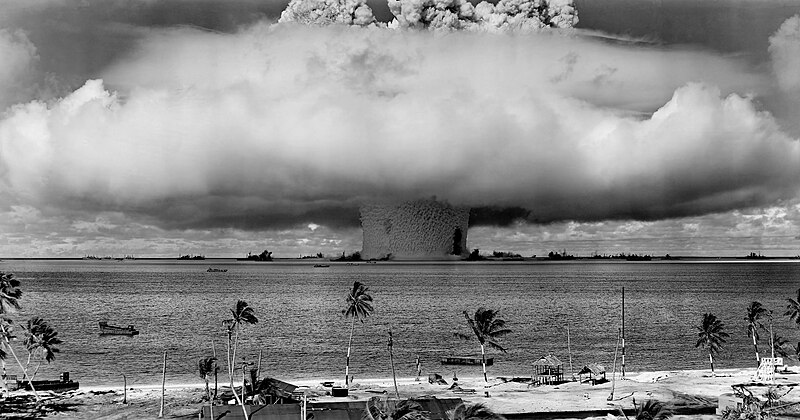
You do know... they nuke the ocean... regularly? Duh.

I swear, it sounds like the OP has never heard of the Bikini Atoll... meh.

800px-Operation_Crossroads_Baker_Edit.jpg


[video=youtube;pJEE7rv5M_E]http://www.youtube.com/watch?v=pJEE7rv5M_E[/video]
 
Last edited:
Top
Sign up to the MyBroadband newsletter
X