The secret to long life? Starve yourself on alternate days

mercurial

MyBB Legend
Joined
Jun 12, 2007
Messages
40,900
Reaction score
2,694
Location
/\/¯¯¯¯¯\/\
The secret to long life? Starve yourself on alternate days to boost brain power and shed weight.

Starving yourself on alternate days can make you live longer, according to scientists.

A group of Americans have said that fasting on and off can boost brain power and help to lose weight at the same time.
The National Institutes for Aging said their research was based on giving animals the bare minimum of calories required to keep them alive and results showed they lived up to twice as long.

The diet has since been tested on humans and appears to protect the heart, circulatory system and brain against age-related diseases like Alzheimer's.
'Dietery energy restriction extends lifespan and protects the brain and cardiovascular system against age-related disease,' said Mark Mattson, head of the laboratory of neurosciences at the NIA and professor of neuroscience at John Hopkins University in Baltimore.

'We have found that dietary energy restriction, particularly when administered in intermittent bouts of major caloric restriction, such as alternative day fasting, activates cellular stress response pathways in neurones,' he said to the Sunday Times.

In one set of experiments, a group of mice were only fed on alternate days while others were allowed to eat daily.
Both groups were given unlimited access to food on the days they were allowed to eat and eventually consumed the same amount of calories.

Professor Mattson said he found the mice fed on alternate days were more sensitive to insulin and needed to produce less of it.
High levels of the hormone, which is produced to control sugar levels after a meal or snack, are usually associated with lower brain power and are at a higher risk of diabetes.

The brains from both sets of rodents were then examined and Professor Mattson said he found the calorie restricted diets appeared to improve the function of brain synapses.

These are the junctions between brain cells which promote the generation of new cells and make them more resistant to stress.
Previous research has found that starving yourself for a few days can help in the fight against cancer.

Scientists found that depriving healthy cells of the food they need sends them into a survival mode, making them highly resistant to stress and damage caused from chemotherapy.

Experts have described the behaviour similar to animals waiting out the winter by hibernating.

Source
 
Its not about starving yourself but about intermittant fasting to reduce the insulin stress on your body and make your body more insulin sensitive, thus improving fat burning efficiency.

It's quite well documented.

See www.marksdailyapple.com (General Paleo diet with intermittant fasting)
See www.leangains.com (IF and body building)

Below is an excerpt from leangains...
http://www.leangains.com/2010/10/top-ten-fasting-myths-debunked.html

1. Repetition. Repeat something often enough and it becomes the truth. If everyone is saying the same thing, it must be true. No need to look into it and think for yourself. The fact that bodybuilders and fitness celebrities keep propagating these myths doesn't help either. Most people reason that if these people do it, it must be great. Unfortunately, bodybuilders and fitness celebrities might just be one of the last people on earth you should listen to if you want objective and accurate opinions in nutrition.

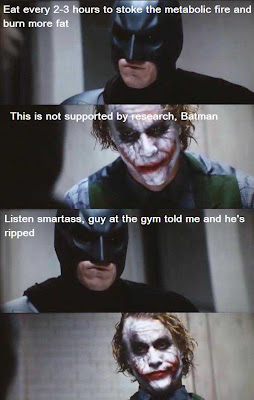
Batman+and+Joker+Diet+Discussion.jpg


2. Commercial forces. For example, the supplement industry benefits greatly from people believing that frequent feedings provide a metabolic advantage. People don't have time to eat six cooked meals a day. Instead, they turn to meal replacement powders, shakes and protein bars. The cereal and grain industry benefits by preaching about the virtues of breakfast for weight control, health and fat loss. There's no commercial incentive in telling people that they would do just fine with three squares a day.

3. Few people have the knowledge or interest needed to interpret the scientific evidence and draw their own conclusions. In order to do this you would need an academic background that included critical examination of studies and study methodology as part of the learning process.

However, an academic background, or an extensive education in nutrition or physiology, seems to correlate very poorly with truthfulness and objectivity in the field of dietetics in my experience. The advice and claims I have seen made by many RDs (Registered Dietitians) has been so shamelessly wrong that I put little stock in anything they have to say. The same goes for many "diet gurus" and so-called health experts with a solid list of academic credentials.

That people who should know better keep repeating the same myths is somewhat puzzling and strange. Perhaps they lose interest in keeping up with research. What we know today is a bit different from what we knew twenty years ago after all. Or maybe they're afraid that their credibility would be questioned if they change the advice they have been giving for years. I'm not sure. I've been thinking about it quite a bit. But I digress. Back to the topic.


Read the rest at the above link at Leangains.

PS: Here's UCT's own Tim Noakes explaining his turn towards Paleo after advocating the usual bunk for years... http://www.timeslive.co.za/lifestyle/2012/02/05/sorry-but-carbo-is-really-a-no-no
 
Last edited:
All gain in life are done systematically and dilligently.

That's it.

Nothing extreme and sporadically.
 
Did you know that your poo is brown because of all the dead red blood cells your body disposes of.

If your body hadn't, much of your output would be similarly coloured as your input.
 
I do this all the time. I don't really starve myself, but I don't eat much either (some days I hardly eat at all). I guess I'll live to be 250, or 900 like Noah.

Edit: Sorry, that's 950 years old.
 
I do this all the time. I don't really starve myself, but I don't eat much either (some days I hardly eat at all). I guess I'll live to be 250, or 900 like Noah.

Edit: Sorry, that's 950 years old.

Remember those are ancient years, so 950/20 actually equals the ripe old age of 45, also not sure how this will work to be honest.
 
I have read somewhere that applied intelligence and hunger is related -- note: not starvation, but hunger.

http://www.nytimes.com/2006/12/10/magazine/10section1C.t-1.html

The researchers then put mice injected with ghrelin and control mice through a maze and other intelligence tests. In each case, the biochemically “hungry” mice — mice infused with ghrelin — performed notably better than those with normal levels of the hormone. The finding was startling, but “it makes sense,” Horvath says. “When you are hungry, you need to focus your entire system on finding food in the environment.” In fact, some biologists believe that human intelligence itself evolved because it made early hominids more effective hunters, gathers and foragers.
 
I do this all the time. I don't really starve myself, but I don't eat much either (some days I hardly eat at all). I guess I'll live to be 250, or 900 like Noah.

Edit: Sorry, that's 950 years old.

Same here. Sometimes there is just no food in the house, or getting food is too much effort, so then you get by on a little amount of food. And then the next day you get food and you eat again, until the cycle repeats again.
 
Top
Sign up to the MyBroadband newsletter
X